Reviews
Part of Bank transfer guide: ACH, wire, instant payment, and internal transfer rails
Bank transfer methods compared: ACH, wire, instant payment and card payout
ACH credits, ACH debits, wires, instant payments, and card payouts compared by direction, speed, settlement, availability, fees, returns, and evidence.
What to take away
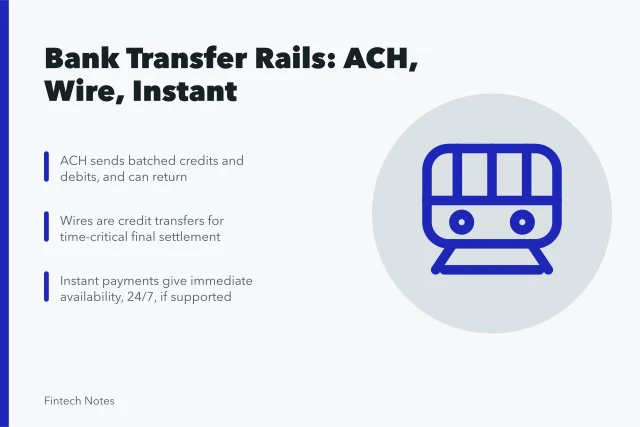
- ACH credit pushes funds; ACH debit pulls them under an authorization.
- Wires are credit transfers built for immediate final interbank settlement after processing.
- Instant payments combine immediate recipient availability with near-real-time settlement on participating services.
- Card payouts use card-network credentials and rules rather than ACH or wire records.
- Interface speed, settlement, availability, and recoverability are separate comparison fields.
Electronic transfer methods can deliver the same dollar amount while producing different records and risks.
Comparison table
Initiation direction
- ACH credit
- Sender pushes
- ACH debit
- Payee or originator pulls
- Wire
- Sender pushes
- Instant payment
- Sender pushes
- Card payout
- Provider sends to card credential
Processing model
- ACH credit
- Batch windows
- ACH debit
- Batch windows
- Wire
- Real-time gross settlement
- Instant payment
- Continuous real-time settlement
- Card payout
- Card-network route
Typical availability
- ACH credit
- Same day or later under provider flow
- ACH debit
- Creditor-specific
- Wire
- Often same business day
- Instant payment
- Seconds on reachable services
- Card payout
- Product-specific
Return or recovery shape
- ACH credit
- Returns and exceptions exist
- ACH debit
- Authorization and return questions matter
- Wire
- Recall request may not recover funds
- Instant payment
- Separate return request or return payment
- Card payout
- Network and provider process
ACH credit
An ACH credit starts with the payer or its service provider. Payroll direct deposit, tax refund, vendor payment, and an account-to-account transfer can use this structure.
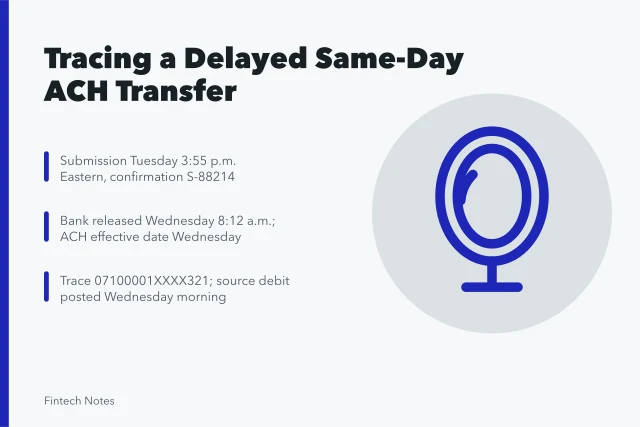
Same-day ACH files must reach the originating bank or its processor by an afternoon deadline, commonly between 2:45 p.m. and 4:45 p.m. Eastern, depending on the window the bank uses.
Next-day files often cut off later, in the afternoon or evening Eastern. Nacha limits same-day entries to $1 million per transaction. Your bank sets the customer deadline, and that deadline is usually earlier than the network one.
Where ACH credit fits
- scheduled or recurring payments;
- batches such as payroll or accounts payable;
- transfers where defined processing windows meet the deadline;
- transactions needing lower direct cost than a wire.
ACH credit risks
Submission cutoffs, effective dates, same-day eligibility, receiving-bank posting, returns, and incorrect account details. A provider can hold a customer instruction before it enters an ACH file.
ACH debit
An ACH debit is initiated by an originator to collect from the payer's account under an authorization. It is common for utilities, loan payments, subscriptions, and business collections.
The payer should retain the authorization, amount rule, frequency, cancellation terms, and notices. The business should connect each debit to a customer mandate and invoice.
Unlike an ACH credit, the recipient side initiates the pull. That changes authorization evidence and return risk.
Wire transfer
The Federal Reserve describes the Fedwire Funds Service as a real-time gross settlement credit-transfer service in which processed transfers are immediate, final, and irrevocable between participating institutions. Customer cutoffs and bank review still occur before a payment reaches that stage.
Customer wire cutoffs commonly fall between 3:00 p.m. and 5:00 p.m. local time for a same-day domestic send. The Fedwire Funds Service closes at 7:00 p.m. Eastern on business days. A payment submitted after the bank's own cutoff goes out the next business day.
Where wires fit
- high-value or time-critical payments;
- closings and treasury transfers with verified instructions;
- situations where the parties require a wire record.
Wire risks
Higher fees, strict cutoffs, intermediary details, rapid finality, and business-email-compromise risk. Verify every new or changed instruction outside email.
Instant payment
Instant services are designed so funds become available to the recipient within seconds at any time, with near-real-time interbank settlement. They are credit transfers. A recipient cannot pull money merely by sending a request for payment.
In the United States the main instant rails are the Federal Reserve's FedNow Service and The Clearing House's RTP network. The Clearing House raised the RTP per-transaction limit to $1 million. FedNow launched with a $100,000 transaction limit and has since raised its service ceiling.
Banks often cap customer sends far lower, typically between $1,000 and $25,000 per transaction or per day. Check your bank's limit before promising a specific delivery time.
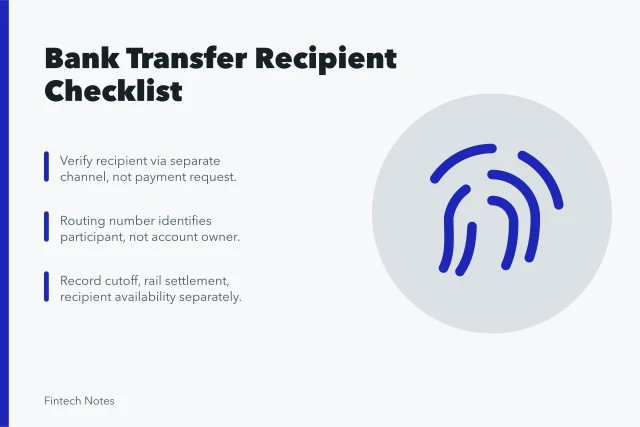
Confirm reachability before promising delivery. A bank may receive instant payments without offering every customer an outgoing option, and a provider may set limits below the service ceiling. Record the sending account, recipient identifier, service name, fee, limit, and final confirmation.
Also distinguish an instant-payment message from an app transfer whose recipient sees an immediate internal balance while the banks settle later. The customer experience can look identical even when the interbank route is different. Ask the provider which event its completed label represents and whether the recipient's funds are available without a separate withdrawal.
The Federal Reserve's instant-payment questions and answers distinguishes instant payments from the broader category of faster payments, which can include same-day ACH. It also describes clearing and settlement in the FedNow model.
Where instant payments fit
- urgent account-to-account payments;
- just-in-time business disbursements;
- weekend or after-hours needs;
- immediate confirmation on reachable accounts.
Instant payment risks
Participation, account eligibility, sending limits, fraud controls, recipient verification, and limited time to stop a mistaken instruction.
Card payout
A card payout sends funds through a card-network route to an eligible debit, prepaid, or other account credential. A platform may call it instant transfer even when the receiving account posts under card rules.
The large card networks are Visa, Mastercard, American Express, and Discover. Push-to-card payouts usually travel on Visa Direct or Mastercard Send. Network rules generally require the issuer to make funds available within about 30 minutes, while the transaction can post to the customer's statement later.
Where card payouts fit
- platform earnings or wallet withdrawals;
- supported cards needing faster availability;
- customer experiences built around a saved card.
Card payout risks
Eligibility, percentage or fixed fee, card replacement, network limits, issuer posting, and separate funding versus payout records.
Speed comparison
Break speed into stages:
Five Stages of Payment Speed
- Provider intakeWhen provider accepted instruction
- ReleaseWhen approved and submitted
- RailWhen processing and settlement occurred
- Recipient postingWhen receiving institution recorded it
- AvailabilityWhen recipient could use it
Clock / Question
- Provider intake
- When did the provider accept the instruction?
- Release
- When did it approve and submit it?
- Rail
- When did processing and settlement occur?
- Recipient posting
- When did the receiving institution record it?
- Availability
- When could the recipient use it?
Instant interface feedback does not answer all five.
Finality and reversibility
Final settlement does not mean a mistaken recipient will never return money. It means the original payment reached a defined final state between institutions. A later return can be a separate transaction.
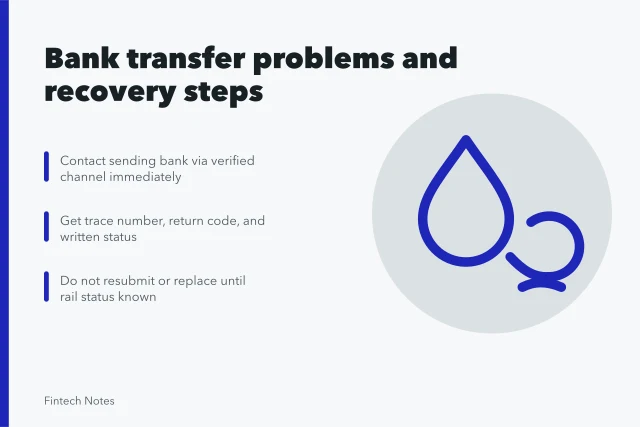
ACH includes structured returns and corrections. Wire and instant recovery often require rapid requests and cooperation. Card payouts follow provider and network processes. Never promise recovery before the receiving side confirms it.
Fee comparison
ACH can be low-cost or free to a customer, while business origination can carry file and item fees. Wires often carry sender and possibly receiver fees. Instant pricing depends on the bank's product. Card payouts often charge for speed.
Every institution sets its own schedule, so treat the figures below as typical ranges rather than quotes.
| Rail | Typical sender cost | What drives it |
|---|---|---|
| ACH credit | Often free for consumer transfers; business origination often $0.20 to $1.50 per item, plus file fees | Volume, account tier, batch setup |
| ACH debit | Similar item pricing, plus return and authorization handling | Mandate management, return rate |
| Wire | Domestic outgoing often $15 to $35, incoming often $0 to $20, international often $25 to $50 plus a currency margin | Channel, currency, intermediary banks |
| Instant payment | Often $0 to $1 per send, though some banks price it like a small wire | Bank product, FedNow or RTP participation |
| Card payout | Often 1% to 1.75% of the amount, with a minimum around $0.25 to $0.50 | Platform contract, network, payout speed |
Compare the amount the recipient gets, not only the sender's displayed fee.
Evidence comparison
- ACH
- company or originator name, effective date, trace number, return code.
- Wire
- bank confirmation, sender reference, beneficiary and intermediary details.
- Instant
- end-to-end or service transaction ID, sender and receiver institutions, timestamp.
- Card payout
- platform transfer ID, card suffix, card-network or issuer posting reference.
Decision matrix
| Need | Likely candidate | Verify first |
|---|---|---|
| Payroll batch | ACH credit | File deadline and account data |
| Recurring bill collection | ACH debit | Authorization and cancellation |
| Time-critical closing | Wire | Instructions and cutoff |
| Weekend emergency payment | Instant | Reachability and recipient |
| Platform balance withdrawal | Card payout | Card eligibility and fee |
Common questions
Is same-day ACH an instant payment?
No. Same-day ACH still uses processing windows. Instant payments are designed for immediate availability and near-real-time settlement around the clock.
Is a card payout a bank transfer?
It may move value to a bank-linked card, but its rail and evidence are card-based rather than ACH or wire.
Which method is safest?
Safety depends on recipient verification, controls, value, timing, and recovery needs. No rail fixes a fraudulent instruction.
Can an ACH debit be initiated without authorization?
A legitimate originator needs the required authorization. Preserve it and report unauthorized account activity promptly.