Features
Part of Bank transfer guide: ACH, wire, instant payment, and internal transfer rails
Investigating a delayed small-business bank transfer case
Delayed business transfer case showing how to identify the rail, trace submission and settlement, separate a return from delay, prevent duplicates, and reconcile.
What to take away
- A provider status can describe customer submission without proving rail settlement.
- The sender needs the ACH effective date and trace number; the recipient needs those details to search.
- Same-day eligibility depends on submission timing and provider release, not only the customer's click.
- Do not issue a replacement while the first payment's status is unresolved.
- Close the case only after source debit, recipient credit, and invoice records agree.
This fictional case follows a delayed vendor payment. Names, dates, amounts, and references are invented. It demonstrates an evidence-first method rather than a universal bank timetable.
The payment request
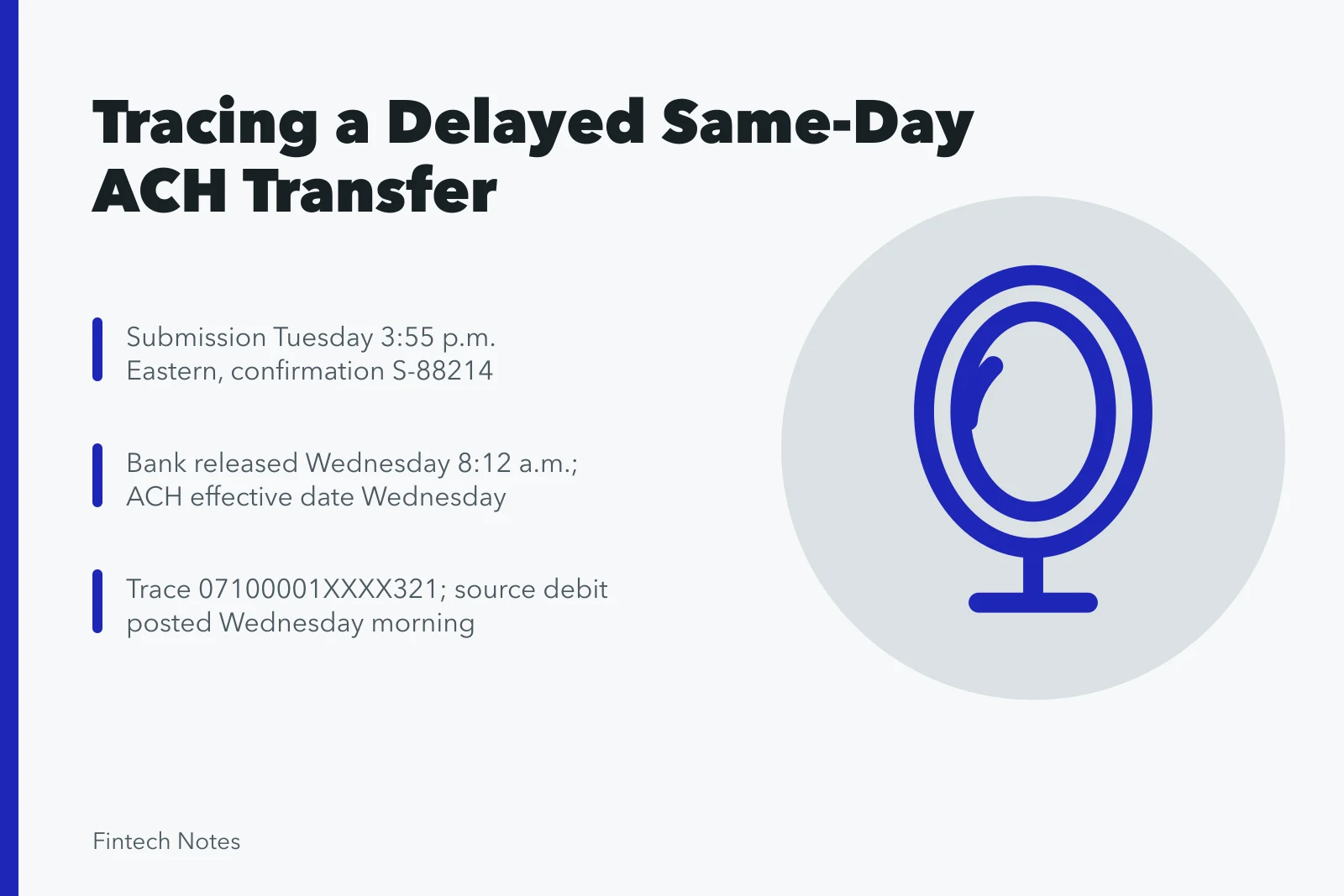
On Tuesday at 3:55 p.m. Eastern, Pine Street Design submits a $4,260 payment to its regular printer, Alto Press. The online portal offers standard and same-day bank transfer. An employee selects same-day and receives confirmation S-88214.
The invoice is due Wednesday. By Wednesday afternoon, Alto Press reports no credit.
The first record
Pine Street saves the portal screen and builds a timeline:
Payment timeline and evidence
- Tuesday 348 p.m. Payment approved internally
- Tuesday 355 p.m. Portal submission S-88214
- ProcessingPortal status screenshot
- Not postedSource-account debit
- Not postedRecipient credit
The team does not call the payment lost. It first asks which rail was selected and whether the bank released it.
Identifying the rail
The bank confirms that same-day bank transfer means an ACH credit in this product. It is not a wire or instant payment.
Same-day ACH cutoff flow
- Customer submits 3:55 p.m. Eastern
- Bank customer cutoff was 3:30 p.m. Eastern
- Instruction entered internal queue
- Not included in Tuesday final same-day file
The Federal Reserve's FedACH processing schedule lists transmission deadlines, target distribution, and settlement windows for eligible same-day and future-dated items. Pine Street does not use the schedule to infer its bank's customer cutoff. It asks when the bank transmitted this item.
The bank explains that its customer cutoff was 3:30 p.m. Eastern. Pine Street's instruction entered an internal queue after that cutoff and was not included in Tuesday's final same-day file.
Finding the effective date
The bank's portal showed same-day as the selected service, but its detailed record shows:
Bank detailed record
- Tue 355 p.m. Customer submission
- Wed 812 a.m. Bank release
- WednesdayACH effective date
- OriginatedStatus
The source debit posts Wednesday morning. The payment is now on the ACH path. It did not settle Tuesday.
Giving the recipient usable evidence
Pine Street sends Alto Press a redacted payment notice containing the amount, effective date, company name, and trace number. It does not send a bank-login screenshot or full account number.
Return vs receiving-bank review
ACH return
- Cause
- Return code event
- Effect
- Payment sent back
- Evidence
- Return code, date, amount
- Next step
- Correct and resend
Receiving-bank review
- Cause
- Name mismatch and fraud flag
- Effect
- Credit held for review
- Evidence
- Trace number locates entry
- Next step
- Work with receiving bank
Alto Press gives the trace to its bank. The receiving bank finds the incoming ACH credit but says it is in account review because the company name differs from the recipient's account title by one punctuation mark and a manual fraud flag was added.
The mismatch did not cause an ACH return. It caused a receiving-bank review. That distinction matters.
Avoiding a duplicate
Alto Press asks Pine Street to send a wire instead. Pine Street declines until the ACH status is resolved. If it sent a wire now and the ACH later posted, Alto Press could receive $8,520.
The parties agree:
Duplicate prevention agreement
- Alto Press works with its bank using ACH trace
- Pine Street keeps invoice open but does not resend
- Both parties update at noon and 4 p.m.
- If ACH returns, record return before replacement
The receiving-bank release
On Wednesday at 2:20 p.m., Alto Press's bank releases the credit. The account record shows the full $4,260. Alto Press confirms receipt from a known telephone number and sends a remittance acknowledgment.
Pine Street matches:
- approved invoice
- $4,260;
- bank debit
- $4,260;
- ACH trace
- ending 321;
- recipient credit
- $4,260;
- payment date
- Wednesday;
- fees
- none charged to recipient.
The invoice is closed once, not on the first portal status.
What if the payment had returned?
A return would create another event with a return code, date, and amount. Pine Street would ask the bank for the cause and determine whether corrected account details, fresh approval, or another method was required.
Financial institutions can exchange ACH exception cases and supporting documents. The Federal Reserve Banks' Exception Resolution Service overview describes a secure mechanism for institutions to manage ACH and FedNow exceptions and search historical FedACH entry details. It is an institutional service, not a customer portal, so Pine Street would work through its bank.
Root-cause review
The accounting team identifies three control gaps.
Cutoff was not recorded
The interface displayed same-day without the team's policy recording the bank's customer cutoff and time zone.
Status language was vague
Staff treated processing as equivalent to sent. The bank's detailed record showed the actual release and trace only later.
Recipient confirmation was informal
The vendor first checked a dashboard without asking its bank to search the ACH trace.
Process changes
Pine Street updates its procedure:
- ACH payments due next day are approved before noon.
- The payment record captures customer cutoff, selected service, effective date, and trace.
- Processing, originated, settled, returned, and credited are tracked as separate states.
- A replacement payment requires finance-manager approval and evidence that the first will not also credit.
- Vendor bank-detail changes are verified independently.
- Recipient acknowledgment is required for time-sensitive invoices.
The case ledger
| Question | Confirmed answer |
|---|---|
| What rail? | ACH credit |
| When submitted by customer? | Tuesday 3:55 p.m. |
| When released by bank? | Wednesday 8:12 a.m. |
| Effective date? | Wednesday |
| Did it return? | No |
| Why recipient delay? | Receiving-bank review |
| When available? | Wednesday 2:20 p.m. |
| Was replacement sent? | No |
Lessons from the case
The customer missed its bank's same-day cutoff, but the transfer itself did not fail. The trace number let the receiving bank locate the entry. Waiting prevented a duplicate, and final reconciliation connected the payment to the invoice.
The phrase bank delay would have been too vague. The real timeline included a customer cutoff, next-day origination, receiving-bank review, and final availability.
Common questions
Did the Federal Reserve schedule prove when Pine Street's bank would accept the order?
No. It describes FedACH processing windows. The bank's customer cutoff and release process were separate.
Was the name difference an ACH return?
No. In this fictional case, the receiving bank reviewed the item and later released it without returning it.
Why not send a wire immediately?
The ACH had already been originated. A wire could have created a duplicate payment.
What record unlocked the investigation?
The ACH trace number, combined with amount, effective date, and company name, let the receiving bank find the entry.