Reviews
Part of Digital payments guide: money, messages, ledgers, clearing, and settlement
Cash, bank deposits, electronic money, and stablecoins compared
Cash, bank deposits, electronic money, and stablecoins compared by issuer, holder claim, ledger, redemption, settlement, insurance, access, and risk.
What to take away
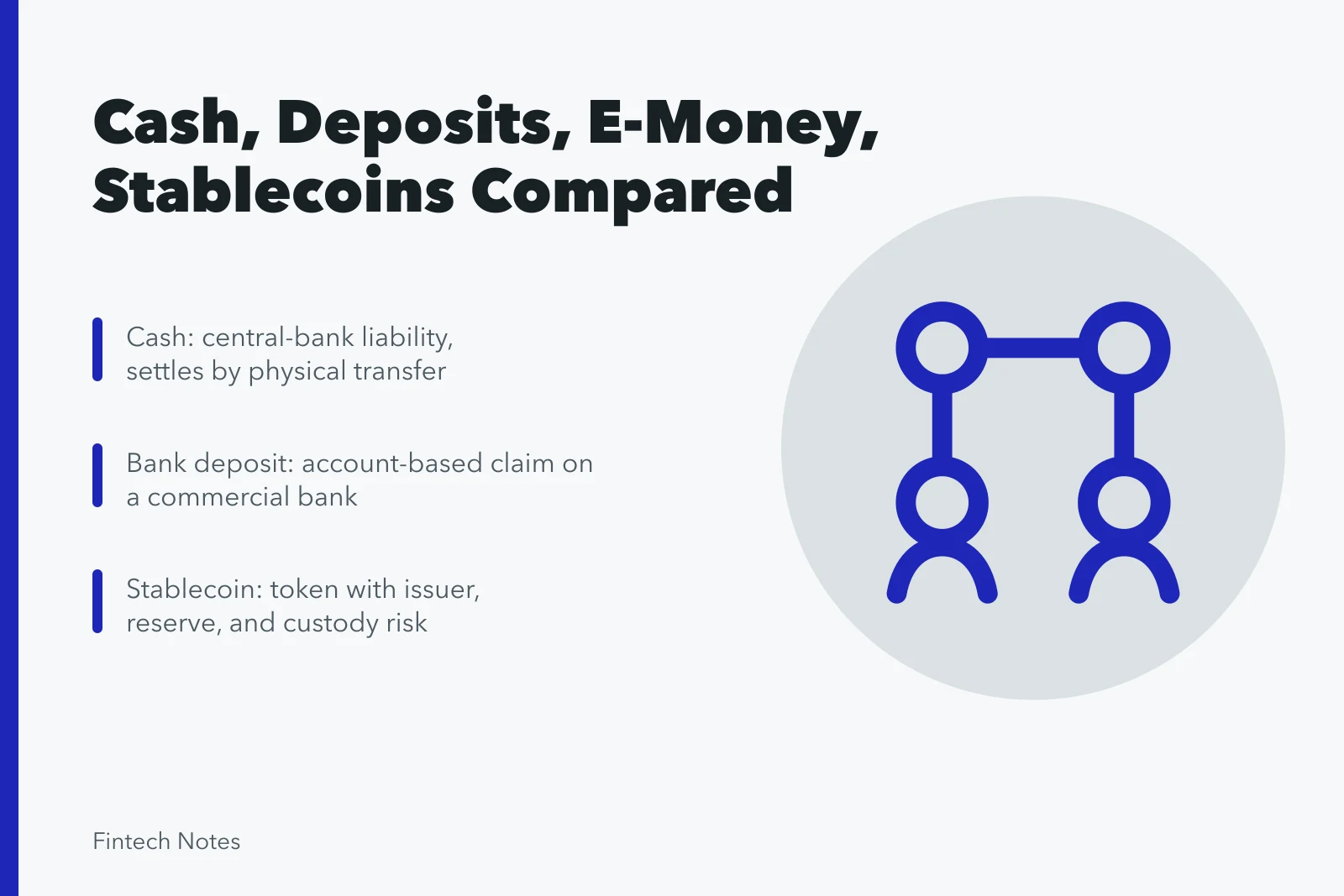
- Cash is a direct central-bank liability in physical form; a commercial bank deposit is a claim recorded by a bank.
- Electronic money in a nonbank app can be a claim on the provider rather than a deposit in the user's name.
- A stablecoin is a token designed to maintain a reference value, but design and redemption terms do not erase issuer, reserve, custody, or market risk.
- The payment interface does not identify the legal form of the balance.
- Compare issuer, claim, redemption, insurance, settlement, access, and failure treatment before comparing speed.
"Digital dollar" can describe several unlike things. A bank-account balance, a payment-app balance, and a dollar-referenced token may all display $100, yet the holder can have a different legal claim, a different path to redemption, and different protection if an intermediary fails.
This comparison uses broad U.S. categories for education. Product terms and regulation can change, and a specific arrangement may combine several forms.
Comparison table
Physical cash
- Basic form
- Note or coin
- Named examples
- Federal Reserve notes, including the $20 bill
- Primary issuer or obligor
- Central bank or sovereign authority
- Holder's position
- Possession of physical money
- Transfer method
- Physical delivery
- Redemption
- Already denominated cash
- Main dependency
- Authenticity and physical custody
Commercial bank deposit
- Basic form
- Account entry
- Named examples
- Checking account at an FDIC-insured bank, such as JPMorgan Chase or Bank of America
- Primary issuer or obligor
- Commercial bank
- Holder's position
- Claim on bank
- Transfer method
- Bank payment rail or book transfer
- Redemption
- Withdrawal or payment from account
- Main dependency
- Bank, account access, and payment system
Nonbank electronic money
- Basic form
- Provider ledger balance
- Named examples
- PayPal, Venmo, or Cash App balance
- Primary issuer or obligor
- Nonbank provider
- Holder's position
- Contractual claim under provider terms
- Transfer method
- Provider ledger or linked rail
- Redemption
- Transfer or withdrawal under terms
- Main dependency
- Provider, safeguarding structure, and partners
Dollar-referenced stablecoin
- Basic form
- Token or ledger unit
- Named examples
- USDC, USDT, or PYUSD
- Primary issuer or obligor
- Stablecoin issuer or defined arrangement
- Holder's position
- Token plus stated redemption or market rights
- Transfer method
- Distributed or permissioned ledger transfer
- Redemption
- Issuer redemption or market sale, if available
- Main dependency
- Issuer, reserves, custody, ledger, and liquidity
The table is a starting map. It does not state that every product in one column has identical protection.
Four Forms of Money
Physical cash
- Basic form
- Note or coin
- Issuer
- Central bank
- Holder claim
- Possession
- Transfer
- Physical delivery
- Redemption
- Already cash
- Main dependency
- Custody
Bank deposit
- Basic form
- Account entry
- Issuer
- Commercial bank
- Holder claim
- Claim on bank
- Transfer
- Bank rail
- Redemption
- Withdrawal
- Main dependency
- Bank and system
Electronic money
- Basic form
- Provider balance
- Issuer
- Nonbank provider
- Holder claim
- Contractual claim
- Transfer
- Provider ledger
- Redemption
- Under terms
- Main dependency
- Provider structure
Stablecoin
- Basic form
- Token or ledger unit
- Issuer
- Stablecoin issuer
- Holder claim
- Token plus rights
- Transfer
- Ledger transfer
- Redemption
- Issuer or market
- Main dependency
- Issuer and reserves
Physical cash
Cash settles by physical transfer. The payer gives the payee notes or coins, and no remote provider must update a customer account for the exchange to occur.
In the United States, the notes are Federal Reserve notes, including the $20 bill.
Strengths and limits
- immediate face-to-face transfer;
- no account, device, or network required;
- broad usefulness for small domestic payments;
- direct possession by the holder;
- theft, loss, fire, and counterfeit risk;
- difficult remote transfer;
- poor recovery after mistaken delivery;
- physical handling and storage cost;
- no automatic transaction history.
Cash privacy is practical, not absolute. Cameras, receipts, serial-number records, and surrounding activity can create evidence.
Commercial bank deposits
A deposit is an account-based claim on a bank. The bank maintains the ledger, and the customer uses payment instruments and services to direct transfers or withdrawals.
Common examples are checking accounts at JPMorgan Chase or Bank of America.
Federal Reserve Governor Christopher Waller described the U.S. mix in a speech dated September 29, 2025. He listed central bank money in cash, commercial bank money in bank deposits, and nonbank electronic money in payment-app balances. Stablecoins are another form of private money. That payment-money distinction helps separate the balance from the app or instrument used to move it.
Strengths and limits
- integrated payment, withdrawal, and account services;
- established records and statements;
- potential federal deposit insurance when eligibility requirements are met;
- access to regulated error and complaint processes for covered activity;
- account restrictions, operational outages, and identity checks;
- payment timing and cutoff rules;
- fraud and unauthorized access;
- balances above applicable insurance limits;
- intermediary dependence for remote payments.
A bank app does not turn a deposit into a different form of money. It changes the access channel.
Nonbank electronic money
Here, "electronic money" means a value balance maintained by a nonbank provider for payment or transfer. The provider may keep customer-level entries on its own ledger and place backing funds with one or more banks or in another safeguarding arrangement.
PayPal, Venmo, and Cash App balances are common examples.
The user's position depends on the contract and structure:
- Is the user the recognized owner of a bank deposit?
- Does the provider hold pooled funds for customers?
- Are records sufficient for pass-through insurance if a bank fails?
- What happens if the nonbank, rather than the partner bank, fails?
- Can the balance be withdrawn at par, and how quickly?
- May the provider freeze or reverse entries?
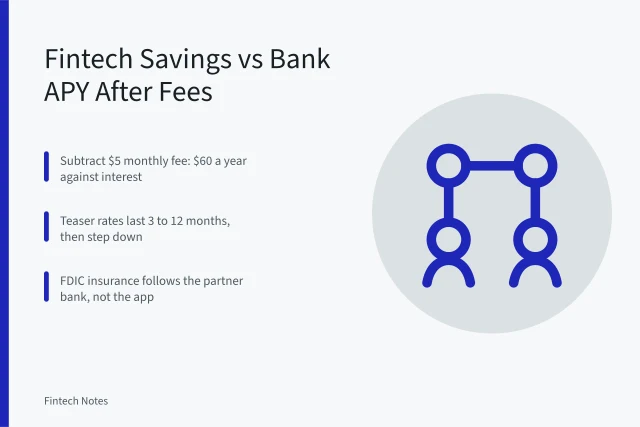
Do not infer federal insurance from a bank logo or partner-bank name. Confirm the entity, placement of funds, recordkeeping conditions, and event the insurance covers.
Stablecoins
A stablecoin is a digital asset designed to maintain a stable value relative to a reference, often one U.S. dollar. It may circulate on a public blockchain, a permissioned ledger, or several networks.
USDC, USDT, and PYUSD are widely used dollar-referenced tokens. Issuer attestations and reports state reserve sizes, and those figures change over time.
Stability depends on structure and behavior, not the name. Review:
- issuer and regulatory status;
- eligible holder and direct redemption rights;
- reserve assets and custody;
- frequency and independence of reserve reporting;
- fees, minimums, and redemption time;
- token contract and supported networks;
- freeze, upgrade, blacklist, and recovery powers;
- secondary-market liquidity and price;
- treatment during issuer, custodian, or network failure.
A token trading near one dollar is not the same thing as an insured bank deposit. A reserve account held by an issuer at a bank is also not automatically an insured deposit owned by each token holder.
Compare protection without slogans
The FDIC's insured-deposits guide, dated July 2024, states that insurance protects eligible deposits at an insured bank if that bank fails. The standard limit is $250,000 per depositor, per insured bank, per ownership category.
Standard ownership categories include single accounts, joint accounts, certain retirement accounts, revocable trust accounts, irrevocable trust accounts, employee benefit plan accounts, corporation and partnership accounts, and government accounts.
The guide distinguishes deposits from investments. It does not insure every dollar-denominated product or protect against every kind of loss.
Use four separate questions:
- What entity owes the holder?
- What event does the protection cover?
- What eligibility, recordkeeping, and limit rules apply?
- What losses remain outside the protection?
Fraud reimbursement, insolvency protection, collateral backing, and price stability are different claims.
Compare transfer and settlement
Cash
- Can transfer happen inside one ledger?
- Not applicable
- Does transfer require outside settlement?
- No remote settlement
- Can recipient access be restricted?
- Physical possession controls
- Can a mistaken transfer be reversed?
- Rarely without recipient
Deposit
- Can transfer happen inside one ledger?
- Yes, within bank
- Does transfer require outside settlement?
- Often for interbank payment
- Can recipient access be restricted?
- Yes
- Can a mistaken transfer be reversed?
- Depends on rail and law
Electronic money
- Can transfer happen inside one ledger?
- Often
- Does transfer require outside settlement?
- Often for funding or withdrawal
- Can recipient access be restricted?
- Yes
- Can a mistaken transfer be reversed?
- Depends on terms and rail
Stablecoin
- Can transfer happen inside one ledger?
- Yes, on supported ledger
- Does transfer require outside settlement?
- Often for purchase or redemption
- Can recipient access be restricted?
- Wallet or issuer controls may apply
- Can a mistaken transfer be reversed?
- Ledger transfer may be irreversible, separate recovery may exist
Speed at one layer can hide delay elsewhere. A stablecoin can move on-chain quickly while bank redemption takes longer. An app can credit instantly while settlement or withdrawal remains pending.
Transfer and Settlement
Cash
- One-ledger transfer
- Not applicable
- Outside settlement
- No remote
- Recipient restricted
- Possession
- Mistake reversed
- Rarely
Deposit
- One-ledger transfer
- Yes
- Outside settlement
- Often
- Recipient restricted
- Yes
- Mistake reversed
- Depends
Electronic money
- One-ledger transfer
- Often
- Outside settlement
- Often
- Recipient restricted
- Yes
- Mistake reversed
- Depends
Stablecoin
- One-ledger transfer
- Yes
- Outside settlement
- Often
- Recipient restricted
- Wallet controls
- Mistake reversed
- May be irreversible
Use a claim map
For any product, fill in:
Field / Answer to verify
- Display name
- Product and balance label
- Legal provider
- Entity named in terms
- Form of value
- Deposit, stored balance, token, or other claim
- Holder claim
- Who owes what to the user
- Backing
- Assets, segregation, and custodian
- Redemption
- Eligible party, price, fee, limit, and timing
- Transfer rail
- Provider ledger, bank rail, or token network
- Protection
- Exact covered event and conditions
- Failure plan
- Bank, nonbank, issuer, custodian, and network scenarios
If a field cannot be verified, treat it as unknown rather than filling it with the product's marketing language.
Which should I use
For everyday payments, a bank deposit gives the broadest acceptance and federal insurance up to the limit. A nonbank app balance is convenient for small peer payments but depends on provider terms. Cash works when both sides are present. A stablecoin suits cross-border or on-chain transfers when the issuer and redemption route are clear.
Keep savings in an insured deposit unless you can verify equal protection elsewhere. For most U.S. households, a checking or savings account remains the default for both payments and savings.
Common questions
Is money in a bank app electronic money?
Check the legal account behind the screen. The balance may be a bank deposit.
Does a stablecoin equal one dollar?
It targets a reference value. Reserves, fees, redemption terms, and market price decide what a holder receives.
Is cash risk-free?
No. It carries physical loss, theft, and counterfeit risk.
Can a nonbank app balance be insured?
Sometimes, through pass-through coverage. Confirm the structure, and note that bank-failure insurance does not cover every nonbank failure.