Guides
Fintech Savings Rate vs Bank APY: Compare After Fees and Teaser Rates
Compare fintech savings APY fees side by side, because teaser rates and monthly charges can erase the headline yield after the promotional period ends.
What to take away
- A headline APY is not net yield. Subtract monthly fees, minimum balance penalties and out-of-network costs before you compare two accounts.
- Teaser rates usually last a set period, often 3 to 12 months, then step down to a lower ongoing rate. Ask for both numbers in writing.
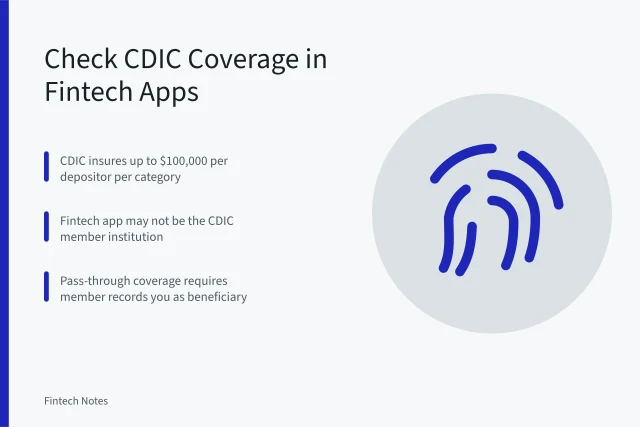
- FDIC insurance follows the bank holding the deposits, not the app brand. Confirm the bank and the ownership category.
- The FDIC publishes national deposit rate benchmarks you can use as a floor for judging any offer.
- No product in this comparison fixes the core problemrates move, and a promotional rate is a marketing decision, not a promise.
What is being compared
Two delivery models now compete for the same savings dollar. The first is a US bank account, opened directly with an institution whose APY sits on its own rate sheet. The second is a fintech savings product, usually an app that places your money at a partner bank and quotes a rate the app controls.
The money often lands in the same place. The difference is who sets the rate, who charges the fee, and who answers when something goes wrong. For background on how these products are structured, see digital account guide: banks, nonbanks, balances, insurance, and access.
The criteria that matter
| Criterion | Why it decides the outcome |
|---|---|
| Ongoing APY after the promo | The rate you actually keep, not the launch number |
| Monthly or annual fee | A $5 monthly fee costs $60 a year against your interest |
| Minimum balance to earn the rate | A $1,000 floor can zero out yield on small balances |
| Rate guarantee period | Tells you how long the quoted number holds |
| Deposit insurance path | Names the bank and the FDIC coverage category |
| Transfer and withdrawal limits | Speed and cost of getting money back out |
| Complaint history | Public record of unresolved problems |
Option by option
National brick-and-mortar banks. Rates are usually low, but the account is simple, the branch exists, and the fee schedule is stable. A reader who wants one institution for checking, savings and a loan is often better served here.
Online-only US banks. These compete directly on APY and typically carry no monthly fee. They hold their own charter and their own deposits. The trade is no branch and slower cash handling.
Fintech savings apps. These quote competitive APYs, often with a promotional bump for new deposits. The rate is set by the program, not the bank, so it can change without a rate-sheet revision. Fees vary widely, and some products charge for instant transfers.
Credit union savings. Member-owned, often with a modest APY and a small membership deposit. Good for a reader who values local service and stable terms over the highest number.
Treasury money market funds and T-bills. Not deposit accounts, no FDIC coverage, but they track short-term rates closely. The Federal Reserve publishes selected interest rates that give you a market benchmark for judging any savings offer.
Where each one wins
- The national bank wins when you need a branch, a notary or a same-day cash deposit.
- The online bank wins when the ongoing APY is high and the fee schedule is empty.
- The fintech app wins when the promotional rate is genuine, the fee is zero, and the partner bank is named on the account agreement.
- The credit union wins when the rate is close enough and the service relationship matters more.
- The Treasury option wins when you want the rate tied to the market rather than to a marketing calendar.
How to compare net yield
- Write down the promotional APY and the date it expires.
- Write down the ongoing APY that applies afterward.
- Add every fee for twelve months, including transfer and inactivity charges.
- Convert fees to an effective rate drag by dividing total fees by your average balance.
- Subtract the drag from each APY and compare the two results.
A $10,000 balance earning 4.50% grosses about $450 a year, using an illustrative figure. A $5 monthly fee removes $60, leaving roughly $390, or about 3.90%. That gap is the whole argument for reading the fee schedule before the rate.
How to compare net yield
- Write down promotional APY and expiry date
- Write down ongoing APY afterward
- Add every fee for twelve months
- Convert fees to effective rate drag
- Subtract drag and compare results
What none of them solve
The shared limitation is that no savings rate is fixed. Every APY in this comparison can fall next quarter, and a promotional rate can fall the day the window closes. The FDIC's national rates and rate caps page shows how far national averages sit below the best advertised offers, which is a useful reality check.
Deposit insurance is also not a rate guarantee. It protects the balance up to the coverage limit if the bank fails. The FDIC deposit insurance resources explain the ownership categories that decide how much of your money is covered.
Before opening anything, run the account through a digital bank and finance app due-diligence checklist. It forces you to name the partner bank, the fee schedule and the complaint record in one place.