Guides
Bank transfer guide: ACH, wire, instant payment, and internal transfer rails
Bank transfer guide to ACH credits and debits, wires, instant payments, internal transfers, timing, settlement, fees, returns, and transaction records.
What to take away
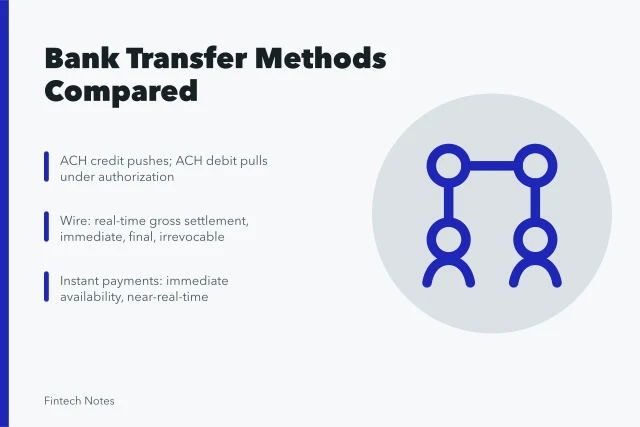
- Bank transfer is a button label, not a rail. The same two words can route money through ACH, a wire, an instant service, or a book entry that never leaves one bank.
- ACH is a batch system. The Federal Reserve runs the network and Nacha writes the operating rules, including the return window a receiving bank works inside.
- A wire is a credit transfer built for final settlement. Once the receiving bank credits the beneficiary, the sending bank can only ask for the money back.
- Instant payments settle between participating institutions around the clock and give the recipient immediate availability. Participation decides who can send and who can receive.
- An internal transfer is a book entry on one institution's ledger. It can look instant and still sit behind a hold, a limit, or an account review.
A transfer screen hides the route. Two buttons with the same label can send money down different rails, and the rail sets the timing, the fee, the recipient data you need, and whether the payment can come back.
This guide covers U.S. domestic transfers. Cross-border remittances, securities transfers, and treasury products run on separate rules.
Start with the instruction
A customer tells a bank or payment provider to move an amount from a source account to a recipient. The provider picks or discloses a rail, checks the instruction, and writes transaction records.
Payment Instruction Flow
- Sender gives instruction
- Provider picks rail
- Provider checks instruction
- Provider writes records
- Settlement between institutions
- Availability to recipient
Field / What it means
- Sender
- Account owner giving the instruction
- Originating institution
- Institution that submits or books the payment
- Rail
- ACH, wire, instant, internal, or another route
- Receiving institution
- Institution that gets the interbank message
- Recipient
- Intended beneficiary
- Settlement
- Transfer of obligations between institutions
- Availability
- When the recipient can spend the funds
Settlement between banks and availability to a customer are two different events.
ACH credits and debits
The Federal Reserve describes the Automated Clearing House network as a nationwide system where depository institutions send batches of electronic credit and debit transfers. Payroll is the common credit. Mortgage and utility withdrawals are the common debits.
ACH Credit vs ACH Debit
ACH credit
- Direction
- Push funds
- Authorization
- Sender initiates
- Examples
- Payroll, vendor
- Timing
- Effective date
ACH debit
- Direction
- Pull funds
- Authorization
- Payer signed
- Examples
- Bills, withdrawals
- Timing
- Effective date
ACH credit
The sender's institution pushes funds toward the recipient. Direct deposit, vendor payment, and a consumer transfer to another bank all work this way.
ACH debit
A business pulls funds from the payer's account under an authorization the payer signed. Recurring bills and one-time account debits are the usual examples.
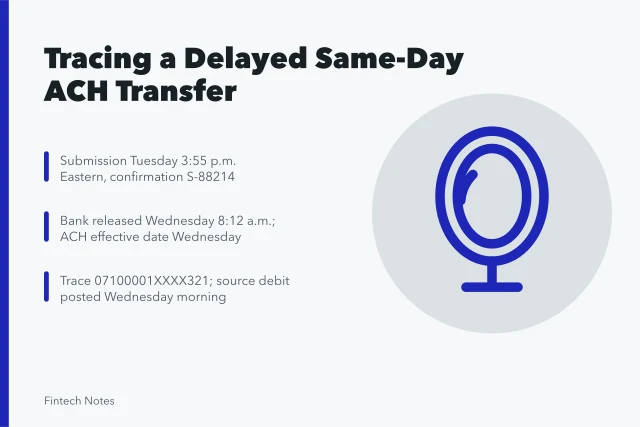
ACH entries carry an effective date and move through processing windows before settlement. Same-day ACH speeds up eligible entries, but a request made today is not automatically a completed same-day payment. Provider cutoffs, review, submission time, and the receiving bank's posting schedule all still apply.
Nacha's same-day windows close at 10:30 a.m. ET, 2:45 p.m. ET, and 4:45 p.m. ET for submission, with settlement later the same day. A request made after the last cutoff moves on the next banking day.
Wire transfers
A domestic wire is a credit transfer. The sender supplies beneficiary and bank details, and the sending bank transmits the payment through a wire system or a correspondent chain.
Wire vs Other Transfers
Wire
- Speed
- Hours
- Fees
- Higher
- Finality
- Hard to recall
- Use case
- High-value
ACH
- Speed
- Windows
- Fees
- Lower
- Finality
- Returnable
- Use case
- Batches
App/remittance
- Speed
- Varies
- Fees
- Varies
- Finality
- Varies
- Use case
- Consumer
Wires suit high-value and time-critical payments. They carry higher fees and hard cutoffs, and final settlement can land within hours. Verify the recipient before you release the money, because after credit the sending bank has no unilateral right to pull it back.
Not every electronic transfer is a wire. A money-transfer app, an international remittance, an ACH transfer, and a bank wire have different operations and different protections.
Instant payments
An instant payment settles between participating accounts in near real time and gives the receiver immediate availability, around the clock. Banks often sell the service under their own brand rather than the rail's name.
In the United States, the two main instant rails are FedNow, operated by the Federal Reserve, and the RTP network, operated by The Clearing House. Typical consumer fees range from $0 to $1 per transfer, though some banks charge more.
Instant Payment Checks
- Sending institution runs identity checks
- Fraud and limit checks still apply
- Recipient must authorize request
- Receiving institution must participate
- Not every customer can send
Instant does not mean careless. The sending institution still runs identity, fraud, limit, and recipient checks. A request for payment is not a completed transfer until the payer authorizes it.
The receiving institution has to participate, or be reachable through the provider's route. A bank that accepts instant payments does not necessarily let every customer send them.
Internal book transfers
When the same bank or provider holds both accounts, the transfer can be recorded entirely on that institution's books. No interbank rail is involved.
Internal transfers often look instant. The provider can still apply holds, limits, account reviews, or withdrawal restrictions, and an app-to-app balance move can be internal even when the later withdrawal goes out over ACH.
Card-funded and card-payout transfers
Some services fund a transfer by charging a debit or credit card. Others deliver money to an eligible card account through a card-network payout. Neither is ACH or a bank wire just because the app shows a bank balance at one end.
Record both legs:
Funding transaction -> provider balance or instruction -> payout transaction
Each leg can carry its own fee, reference, status, and error process.
Timing has several clocks
Do not ask only how long a transfer takes. Record each of these:
- Submission
- when the sender or provider releases the instruction.
- Processing window
- the batch or network window that accepts the entry.
- Settlement
- when institutions exchange obligations.
- Availability
- when the recipient can spend the funds.
- Posting
- when the receiving bank records the credit or debit on the account.
Transfer Timing Clocks
- Customer submission time
- Provider approval or release time
- Rail submission time
- Interbank settlement time
- Receiving-bank posting time
- Recipient availability time
- Return or rejection time
Ask what each status on the screen actually means.
Returns, recalls, and reversals
These three words describe different events, and they are not interchangeable.
Returns, Recalls, Reversals
ACH return
- Who acts
- Receiving bank
- Guarantee
- Reason code
- Scope
- Entry
Wire recall
- Who acts
- Sending bank
- Guarantee
- No guarantee
- Scope
- Funds request
Instant return
- Who acts
- Receiver
- Guarantee
- Agreement
- Scope
- Later transaction
Internal reversal
- Who acts
- Provider
- Guarantee
- Ledger only
- Scope
- Internal
ACH return
The receiving institution sends the entry back under a reason code and inside a time frame set by Nacha's operating rules. A return is not proof the sender canceled the payment at will.
For most return reason codes, the receiving bank has two banking days after settlement to return the entry. Consumer unauthorized-debit returns, such as R10 (customer advises not authorized), can be returned up to 60 days after settlement.
Wire recall request
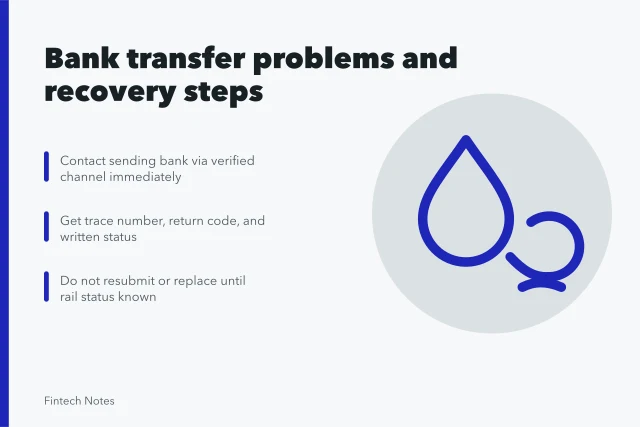
The sending bank asks for the funds back. The request carries no guarantee once the receiving bank has credited the beneficiary or the beneficiary has withdrawn the money.
Instant-payment return
A receiving institution or customer may agree to send funds back through a supported process. The original payment's finality and the later return are separate transactions with separate records.
Internal reversal
The provider corrects its own ledger. That says nothing about how any interbank leg was resolved.
Fees and exchange rates
Compare the whole cost, not the headline:
- sender fee;
- receiver fee;
- intermediary fee;
- expedited-service fee;
- currency conversion rate and markup;
- cancellation or research fee;
- returned-payment charge.
For a domestic same-currency transfer, typical fees are:
These are typical ranges, not fixed prices. Cross-border transfers add a currency conversion markup, often 1 percent to 3 percent above the mid-market rate.
Worked example: send $1,000 domestically. ACH costs $0 to $3 and lands in one to three banking days, or same day before the cutoff. A wire costs $15 to $35 and lands within hours. An instant payment costs $0 to $1 and lands in seconds.
A zero-fee interface can earn its revenue through exchange-rate spread or another product relationship. On a domestic same-currency transfer, confirm whether the recipient receives the full amount.
Recipient verification
Before the first payment, and after any change to the instructions:
Recipient Verification Steps
- Obtain details through known channel
- Call previously verified number
- Read back bank and account details
- Use dual approval for business payments
- Send small test payment
- Treat urgency and secrecy as warning
- Keep verification record
A valid routing number proves the bank exists. It does not prove the account belongs to the person you intend to pay.
Transaction evidence
Keep the payment method and rail, the amount and currency, the sender and recipient names, and the masked account details. Add the submission and settlement dates, the confirmation and trace references, the fee and exchange-rate disclosure, and the approval record. File the recipient confirmation and any return, rejection, or recall correspondence with it.
Transaction Evidence Checklist
- Payment method and rail
- Amount and currency
- Sender and recipient names
- Masked account details
- Submission and settlement dates
- Confirmation and trace references
- Fee and exchange-rate disclosure
- Approval record and recipient confirmation
Do not email full account details in an unprotected attachment.
Common questions
Is every bank-to-bank transfer ACH?
No. It can be ACH, a wire, an instant payment, a card payout, or an internal book transfer. The label on the button does not tell you which one, so check the confirmation record for the rail and the trace reference.
Does same-day ACH mean immediate?
No. Same-day ACH runs inside defined processing windows, and the provider's cutoff plus the receiving bank's posting schedule decide when the money lands. A request made after the cutoff moves on the next window.
Can a wire always be recalled?
No. The sending bank can request a recall, but recovery depends on timing, whether the beneficiary has withdrawn the funds, and the receiving bank's cooperation. A recall request is not a reversal.
Is an app status enough to prove receipt?
No. A status of completed can mean the provider submitted the instruction, not that the recipient's bank made the funds available. When receipt matters, get the rail reference and the recipient-bank confirmation.
In this guide
- How to choose and verify a bank transfer methodMatch a bank transfer method to the payment's deadline, value and recipient, then verify the account details and fees before the money leaves.
- Bank transfer methods compared: ACH, wire, instant payment and card payoutACH credits, ACH debits, wires, instant payments, and card payouts compared by direction, speed, settlement, availability, fees, returns, and evidence.
- Bank transfer details, timing, fee, and recipient checklistBank transfer checklist for recipient details, routing information, rail, timing, fees, independent verification, dual approval, confirmation, and records.
- Bank transfer problems: wrong recipients, cutoffs, scams and irreversible mistakesBank transfer problems explained: wrong recipients, rejected details, ACH returns, missed cutoffs, duplicate payments, wire scams, and recovery requests.
- Investigating a delayed small-business bank transfer caseDelayed business transfer case showing how to identify the rail, trace submission and settlement, separate a return from delay, prevent duplicates, and reconcile.