Guides
Digital account guide: banks, nonbanks, balances, insurance, and access
A digital account guide to naming the entities behind an app, reading a balance label, and checking what insurance and access actually cover.
What to take away
- The brand on the login screen is rarely the entity that holds the money.
- The balance you see may live in a program ledger, not the bank's own customer records.
- Deposit insurance answers one questionwould an insured bank have to fail for this claim to pay.
- Access can break while the funds stay safe, so keep a second route for essential bills.
- Save the agreement that was in force on the transaction date, not the current help page.
An app can look like a bank without being one. Under a single login it may offer several things. These include a deposit account at a partner bank and a prepaid account. They also include a stored balance the provider owes you. A brokerage sweep, a card, or a loan may be offered too.
The way to read it is to replace the brand story with a relationship map. For each feature, name the legal entity and the account. Also name the ledger and the custodian. Then name the payment rail and its protection.
This is general U.S. educational information. What applies to you depends on your agreement, your records and the facts of your account.
Name the legal entities first
Pull the names from the account agreement, the privacy notice, the cardholder agreement and the deposit disclosure. The company in the app store listing does not perform every role.
| Role | Question to answer |
|---|
Name the legal entities
- App brandwho markets and controls the interface?
- Contracting entitywho signs your user agreement?
- Bankwhich insured institution holds deposits?
- Program managerwho administers the program daily?
- Processorwho keeps records or sends payments?
- Card issuerwhich entity issues the card?
- Support operatorwho receives error notices?
One company can hold several of those roles, and several companies can sit between you and the bank.
Direct accounts and intermediated ones
A direct bank account puts you in the bank's own customer records, under the bank's agreement, on the bank's site. A software vendor can supply the app without becoming the account provider.
Account structures compared
Direct bank account
- Who you deal with
- Bank directly
- Where funds sit
- Bank customer records
- Insurance
- Bank deposit insurance
- Failure protection
- Bank failure
Intermediated nonbank
- Who you deal with
- Nonbank marketer
- Where funds sit
- Bank deposit product
- Insurance
- Pass-through possible
- Failure protection
- Bank failure
Custodial or pooled
- Who you deal with
- Nonbank with bank
- Where funds sit
- One pooled bank account
- Insurance
- Pass-through if eligible
- Failure protection
- Bank failure
Nonbank stored balance
- Who you deal with
- Nonbank provider
- Where funds sit
- Provider's own balance
- Insurance
- Not a deposit
- Failure protection
- Provider insolvency terms
In an intermediated arrangement, you deal with a nonbank that markets and services a deposit product at a bank. The bank may lean on outside firms for the system of record, transaction processing, compliance, support and disputes.
A custodial or pooled structure places funds from many users into one bank account, with the detailed user ledger kept elsewhere. Pass-through insurance eligibility turns on ownership, disclosure and recordkeeping.
A nonbank stored balance is a contractual debt the provider owes you, not a deposit in your name. Funding, safeguarding, withdrawal and insolvency treatment come from that structure and those terms.
Brokerage cash can sit at the broker, move into a money market mutual fund, or sweep to one or more banks. Where it sits changes which failure protection applies.
Who keeps the ledger
You may see an app balance while the bank sees one pooled account. The records linking your claim to that pooled money may sit with a program manager, a processor or a middleware provider.
The Federal Reserve, the FDIC and the OCC describe these bank-third-party arrangements in their joint statement on third-party deposit products.
Outside firms may keep the deposit and transaction system of record, process payments, run the app, service accounts and handle complaints. The statement also says using a third party does not diminish the bank's own duty to comply with the law.
For you, that structure raises questions worth writing down.
Ledger questions to write down
- Can the bank identify you and your balance directly?
- Which record controls when app and bank totals differ?
- Does the bank have timely access to the detailed ledger?
- Who reconciles the pooled account against customer balances?
- Who can release funds if the nonbank stops operating?
Do not assume the named bank can search a private transaction ID from the app.
Read the balance label
Labels like cash balance and spending balance describe a function. So do available funds, savings, wallet, reserve, brokerage cash and card balance. They do not identify the legal form.
Read the balance label
- Legal owner of the balance
- Entity that owes it
- Account title at bank or broker
- Whether funds are pooled
- Who keeps the customer-level ledger
- Your withdrawal right and timing
- Protection claim and covered failure
"Held with partner banks" is incomplete until you have the partner names, the placement timing, the ownership records and the conditions.
Check deposit insurance against the right failure
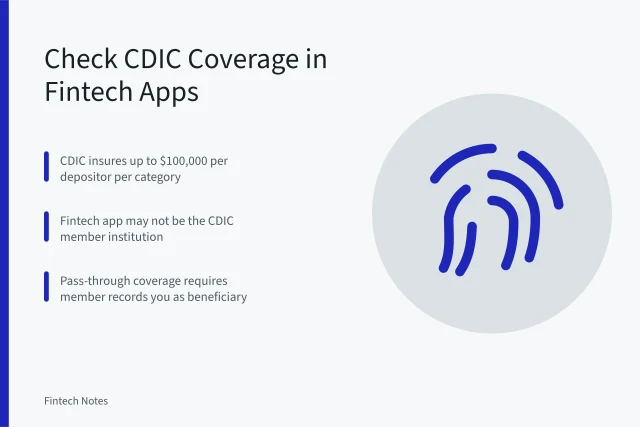
FDIC insurance protects eligible deposits at an insured bank if that bank fails, within limits and ownership categories and subject to record requirements. NCUA share insurance is a separate framework for federally insured credit unions.
Which failure is covered?
Which institution would have to fail for the protection to pay?
FDIC or NCUA insurance may apply
nonbank insolvency, fraud, or outage is not covered
Neither one automatically covers a nonbank app operator becoming insolvent, fraud or theft from your account, or lost access during an outage. It does not cover securities or cryptoasset price moves, or a balance that was never placed as an eligible deposit. Amounts above the applicable limits, and missing or inaccurate beneficial-owner records, fall outside it too.
Ask which institution would have to fail for the protection to pay. That single question exposes most vague claims.
Treat access as its own risk
Funds can sit safely at an insured bank and still be out of reach. The app or its API can go down. Identity verification can break, a profile can be frozen, or a recovery channel can be lost with a phone.
A processor can fail. A bank partner can end the relationship. A ledger reconciliation dispute or a withdrawal limit can hold the balance in place, and so can a legal or compliance hold.
Keep a second route for essential bills. If the account takes business receipts or payroll, export records on a schedule and move funds under a written liquidity policy.
Follow the money between balances
Instant internal transfers and external withdrawals often use different rails. Map the path before you rely on it.
Access risk checklist
- App or API can go down
- Identity verification can break
- Profile can be frozen
- Recovery channel can be lost
- Processor can fail
- Bank partner can end relationship
- Ledger dispute or withdrawal limit can hold funds
Funding account -> app or program ledger -> recipient app balance -> withdrawal instruction -> recipient bank
At each arrow, write down who initiates the payment, which rail carries it, the fee, and the stated timing. Add who holds the right to review or reverse it, how a return works, and the transaction reference.
An internal credit can be spendable inside the app the moment it appears and still not be withdrawable. A bank debit can post before the app balance updates.
Rights differ by transaction type
Card purchase disputes, consumer electronic-fund-transfer errors, remittances, brokerage claims, loan servicing disputes and crypto transfers do not share one error process. The rule that governs depends on the product and the rail.
Keep the account and card agreements, the fee schedule, the privacy notice and the insurance disclosure. Keep the bank and broker names, the error-notice address, support records, and your statements and tax records. The agreement in force on the transaction date can matter more than today's help page.
If a dispute or a complaint is heading toward a regulator, the CFPB and your state attorney general run their own filing processes, and Nacha sets the rules for ACH returns. A licensed attorney can tell you what your agreement allows.
Plan for a partner change or a closure
Apps change banks, processors and program structures. A notice may ask for consent, new routing details, a card replacement or a full account migration.
Before you accept, identify the new legal entities and compare the ownership and insurance language. Note the date the old terms stop and the new ones start.
Update direct deposits and automatic payments only through channels you verified yourself. Download the closing statement from the old program, reconcile balances on both sides of the migration, and keep both sets of terms.
On closure, move funds first where you can. Cancel recurring payments. Download records. Revoke linked access. Get written confirmation.
A one-page account map
Field / Verified answer
- App legal entity
- Account provider
- Bank or credit union
- Account title
- Customer-level ledger keeper
- Balance form
- Deposit placement timing
- Insurance claim
- Covered failure
- Withdrawal rail
- Formal error contact
- Alternate access route
A blank field is a finding, not a reason to guess.
Common questions
Is a neobank a bank?
The marketing category does not settle the legal question. Some brands hold their own charter; others provide access to bank products through a partner arrangement. The agreement tells you which one you have.
If the app names an FDIC-insured partner, is my balance insured?
No conclusion follows from the name alone. Check that the funds were placed as a deposit, who owns them, how the records are kept, which limits apply, and which failure the protection covers. The FDIC's own guidance on pass-through coverage is the place to confirm it.
Can the partner bank unfreeze my app account?
Not necessarily. The nonbank often controls the interface and the identity system, so it controls access. Ask who can release a hold, and who keeps the ledger the hold sits on.
Which record should I keep?
No single document answers every issue. Keep the agreement, the bank identity, the statements, the transaction references and the customer-level balance history together. If the amounts are large or the account is disputed, a licensed attorney can advise on your specific facts.
In this guide
- How to verify who holds and protects money in a finance appA finance app balance can sit at a bank, a broker or a program manager, so verify the legal holder and the protection claim before relying on it.
- Bank account, prepaid account, brokerage cash, and app balance comparedFour products consumers call accounts sit in different legal structures, so deposit insurance, access, and ownership follow the legal record, not the app screen.
- Digital bank and finance app due-diligence checklistDigital bank and finance app checklist covering legal identity, charter, partners, custody, records, insurance, fees, data, security, support, and exit risk.