Guides
Part of Digital account guide: banks, nonbanks, balances, insurance, and access
How to verify who holds and protects money in a finance app
A finance app balance can sit at a bank, a broker or a program manager, so verify the legal holder and the protection claim before relying on it.
What to take away
- Verify one feature at a time. A spending balance, a brokerage cash balance and a rewards wallet can sit under three different agreements.
- The app brand is not the deposit holder. Find the legal entity that owes the balance and the bank that holds it.
- Check the bank in the FDIC's BankFind Suite by legal name or certificate number, not by the logo on the app.
- Read the insurance sentence as a conditionalit names a failure event, a limit and recordkeeping conditions.
- Save dated copies of terms and support replies. Recheck after any partner bank change.
Start with the screen, not the brand
Open the account detail page and screenshot it. Write down the label the app uses, the routing number, the last digits of the account number and the card issuer.
Look for the line that reads "banking services provided by" or "funds held at." That line names the entity doing the holding, and it is often the only place the bank appears.
Keep each feature separate. A brokerage cash balance and a spending balance can show in one total while sitting under two contracts with two sets of protections.
Pull the documents that govern the balance
Download and keep the user agreement, the deposit or account agreement, the cardholder agreement, the sweep disclosure, the fee schedule and the error-resolution notice. Save the deposit-insurance disclosure and the privacy notice with them.
Search each file for these terms:
custodianfor benefit ofomnibussweeppass-throughstored valueSIPCprogram managerCopy the whole clause with its heading, because a single sentence often leans on a definition printed pages away.
Name every entity in the chain
Fill this in from the documents, not from memory:
| Entity | Legal name | Role | Source document |
|---|---|---|---|
| App company | Interface and program | ||
| Bank | Deposit holder | ||
| Broker | Brokerage or sweep | ||
| Program manager | Ledger and servicing | ||
| Card issuer | Card account | ||
| Custodian | Asset holding |
Watch for a subsidiary with a name close to the parent. Record the address and any regulator identifier the document states.
Verify the bank itself
Search BankFind by the legal bank name or the FDIC certificate number. Match the certificate number, the official domain, the headquarters and the active status on the date that matters to you.
A BankFind record proves the institution exists and is insured. It says nothing about where your money sits or whether you qualify for pass-through coverage.
Trace where the money actually sits
Ask when the nonbank receives your deposit, when it places money at a bank, whose name is on that bank account, and which records show your share of it.
Common structures:
- an account opened in your own name at the bank;
- a custodial account titled for the benefit of users;
- a pooled account with a nonbank subledger behind it;
- a sweep that spreads balances across several banks;
- a provider balance with no bank deposit standing behind your share.
Mark any gap between the day the provider receives your money and the day it reaches a bank. Insurance wording often applies only after eligible placement.
Read the protection sentence as a condition
Rewrite the marketing claim in this shape:
If named institution fails, identified balance may be protected by named program, up to applicable limit, if listed conditions are met.
Then test it. Does it cover bank failure, or only nonbank failure? Does it cover fraud, theft or an outage? Are you the depositor of record, or is pass-through treatment claimed on your behalf?
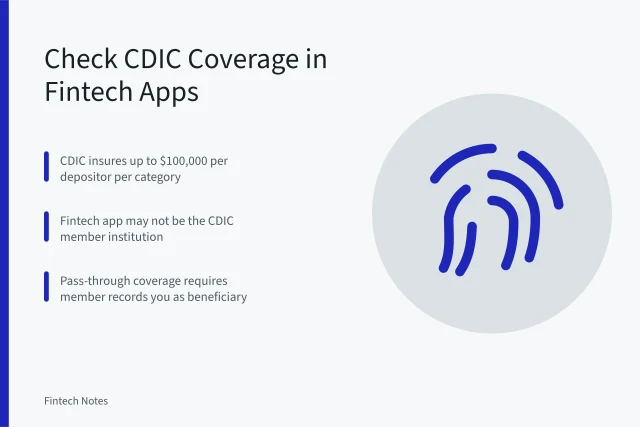
Deposits at one bank in the same ownership category are aggregated for the limit. A sweep splits your money across banks, which raises a further question: when do you get to learn which bank holds your share?
Reject any sentence that never names the failure event.
Ask who keeps the customer records
In a pooled or custodial setup, the bank may never see your name. Try to establish who runs the user subledger, how often totals are reconciled, and who can reach the records if the program manager fails.
Check whether your statement names the bank and the account relationship. Check how a correction travels from the app to the bank, and how a receiver would identify users and balances.
Thin public detail is not proof of bad records. It means you cannot verify that control yourself, so rely on the claim accordingly.
Put the same question to both sides
Ask the app: which legal entity owes my displayed balance, at which bank is it placed today, is the account in my name or pooled, and who keeps the beneficial-owner ledger?
Ask the bank through its official contact channel whether it runs the named deposit program and whether end-user accounts are direct or custodial.
Never send a full account number by unsecured email. Log the date, the channel and the exact limit of each answer.
Test the plumbing with a small amount
Deposit a small sum. Confirm the balance the app shows against the routing details. Make one small purchase or transfer, then withdraw to an outside account.
Compare the fees and the timing you were quoted against what happened, download a statement, and find the formal error channel before you need it.
This test cannot prove how an insolvency would be handled. It does show broken links, vague statements and unreachable support while the amount at risk is small.
Rate what you found
Rating / Meaning
- Verified
- Official institution record plus a consistent agreement and account evidence
- Partly verified
- The bank is real, but placement, title or subledger control stays unclear
- Unverified
- The claim names no institution and no governing detail
- Contradicted
- Terms, official record or support replies conflict with the claim
If it is contradicted, keep the conflict visible. Ask for a correction in writing and stop relying on the protection claim while it stands.
Recheck when the program changes
Run the whole check again when you get notice of a new partner bank. Also rerun it for a revised sweep or a routing change. Rerun it for an account-number change or a card reissue. Rerun it for a merger or a new legal entity. Rerun it for new custody wording.
Keep the old and new terms with their effective dates, and reconcile your balance across the migration boundary. That boundary is where a balance most often lands somewhere you did not expect.
Common questions
Does BankFind list finance apps?
No. It lists FDIC-insured banking institutions. A nonbank brand that offers access to a bank's services will not appear under its own name, so search the bank named in your agreement instead.
Can I confirm pass-through insurance before anything goes wrong?
You can confirm the structure and the conditions the provider states. Whether coverage applies is decided on the facts and the records at the time of a failure, so treat any promise as conditional until you can map it.
Is a routing number proof that my money is insured?
No. A routing number identifies an institution or a payment function. It does not show who owns the account, where the balance sits, or whether you qualify for coverage.
What if support will not name the bank?
Treat the claim as unverified. Keep the reply with its date, and do not leave funds parked on the strength of an insurance promise you cannot trace to a named institution. For a dispute, the CFPB and your state attorney general run their own complaint processes, and a licensed attorney can advise on your situation.