Maintenance
Part of Digital payments guide: money, messages, ledgers, clearing, and settlement
Digital payment product evaluation checklist
Digital payment product checklist for provider identity, fund custody, deposit insurance, fees, timing, privacy, security, errors, outages, and account closure.
What to take away
- Identify the legal provider and the entity that holds customer funds.
- Verify protection by product and failure event, not by brand association.
- Compare total cost, delivery timing, limits, data access, and error handling.
- Test support and recovery before keeping a material balance in the product.
- Save the terms and fee schedule that applied when you enrolled.
A payment product should be evaluated as a chain of promises. The interface may promise a fast transfer, while separate terms govern funding, custody, bank partners, delivery, withdrawal, data use, errors, freezes, and closure.
Use this checklist before opening an account, connecting a bank, accepting business payments, or storing more than a trivial balance. It is educational, not a recommendation or legal interpretation.
1. Provider identity
- Record the product name and website.
- Find the legal entity named in the user agreement.
- Identify its jurisdiction and contact address.
- Determine whether it is a bank, credit union, licensed nonbank, technology provider, or agent.
- Record every bank, card issuer, custodian, or processor named for the feature you will use.
- Confirm which entity handles complaints and error notices.
- Search the appropriate regulator's official directory rather than trusting a badge alone.
A product can place different features with different entities. Its card, stored balance, credit feature, investment account, and token service may not share one provider or protection scheme.
2. Form and location of funds
- State whether the balance is a bank deposit, prepaid balance, nonbank ledger claim, investment, or digital asset.
- Identify where customer funds are placed.
- Determine whether funds are pooled or held in the user's own account.
- Ask who the records identify as beneficial owner.
- Confirm when money moves from the linked bank to the provider.
- Confirm when a recipient credit becomes withdrawable.
- Record any reserve, hold, or negative-balance authority.
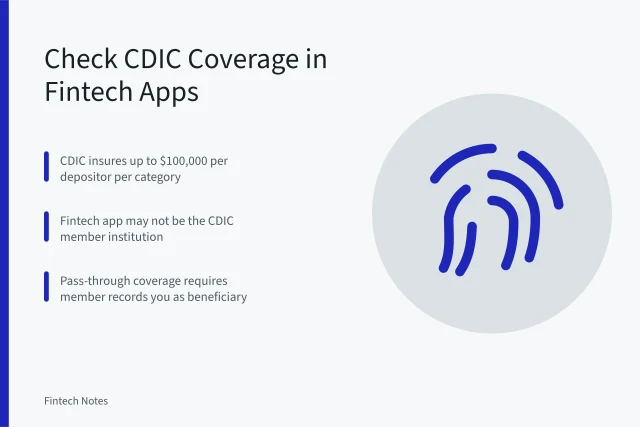
The FDIC warns that third-party apps can depend on a nonbank's placement and recordkeeping, and that deposit insurance does not protect against the nonbank company's insolvency. Its guide to banking with third-party apps also notes that nonbank technology failures may temporarily block access even when funds have been placed at a bank.
3. Protection claims
- Name the protectiondeposit insurance, safeguarding, reserve backing, private insurance, fraud policy, or contractual reimbursement.
- Identify the covered event.
- Record limits, ownership categories, exclusions, and conditions.
- Determine whether enrollment, identity verification, direct deposit, or a card is required.
- Check whether protection applies automatically or only after funds reach another institution.
- Separate bank-failure coverage from fraud, investment loss, token price, and nonbank failure.
- Save the exact disclosure.
Reject vague language such as "bank-level protection" unless the provider defines it. Encryption, reserves, and deposit insurance solve different problems.
4. Funding and withdrawal
- List every allowed funding source.
- Record funding fees and card treatment.
- Note hold periods for new funds.
- Record standard and instant withdrawal fees.
- Note daily, weekly, and monthly limits.
- Confirm destination-name matching rules.
- Check withdrawal timing by weekend, holiday, and cutoff.
- Determine whether the provider can delay withdrawal during review.
Test a small inbound and outbound transfer. Record actual initiation, posting, and availability times rather than treating the marketing estimate as a guarantee.
5. Recipient and mistake controls
- Confirm what recipient information is displayed before sending.
- Check whether the product verifies names or only routes by identifier.
- Learn whether a payment can be canceled before acceptance.
- Identify the process for a wrong recipient.
- Find the duplicate-payment and nonreceipt process.
- Check whether business and personal payments have different protections.
- Record any purchase-protection exclusions.
A reversible card purchase, an account-to-account instant payment, and an internal wallet transfer can have different recovery options even inside one app.
6. Fees and exchange rates
- Capture the full fee schedule.
- Identify transfer, receipt, withdrawal, card, inactivity, and service fees.
- Check whether the fee is added to the sent amount or deducted from proceeds.
- Compare the quoted exchange rate with the provider's reference and spread disclosure.
- Record intermediary and recipient-bank deductions where applicable.
- Determine whether a linked credit card may treat funding as a cash advance.
- Test the amount the recipient will receive, not only what the sender pays.
Calculate cost for your real transaction size. A fixed fee and a percentage fee rank differently at $20 and $2,000.
7. Timing and status
- Find definitions for pending, sent, complete, received, reversed, and returned.
- Identify the payment rail used by each method.
- Separate authorization, posting, settlement, and availability.
- Record cutoffs and business-day definitions.
- Check the provider's right to hold a transaction for review.
- Find service-status and outage communication channels.
- Confirm whether recipient notification means funds are available.
If the product gives no status definitions, ask support before using it for payroll, rent, tax, or another deadline-sensitive payment.
8. Data access and privacy
- List information collected at signup and during transactions.
- Identify bank-account data, contacts, location, device, and behavioral data accessed.
- Check whether contact upload is optional.
- Identify service providers and sharing purposes.
- Determine how to revoke bank or data connections.
- Check deletion, retention, and account-closure terms.
- Record whether the product can initiate payments or only read data.
The Consumer Financial Protection Bureau advises checking what data a service accesses, how it uses and shares the information, how access can be revoked, and whether it can move money in its financial data-sharing questions. A password change alone may not terminate every authorized connection.
9. Security and recovery
- Enable the strongest supported authentication.
- Protect the email and phone account used for recovery.
- Record device and session controls.
- Turn on transaction and profile-change alerts.
- Find the lost-device and account-takeover process.
- Check whether support will ever request a password or one-time code.
- Store recovery information outside the device.
- Test how to lock the product without closing the underlying bank account.
Never conduct a recovery drill that risks locking an active account. Review the steps and confirm contacts instead.
10. Errors and complaints
- Locate the formal error-notice address or in-app route.
- Record deadlines and required information.
- Distinguish fraud report, payment trace, merchant dispute, and complaint.
- Check whether oral notice begins an investigation for covered transactions.
- Identify provisional-credit rules without assuming eligibility.
- Find the regulator or ombudsman for unresolved issues.
- Preserve receipts, statements, screenshots, and support logs.
Support chat can gather facts, but do not assume it satisfies every formal notice rule. Use the channel named in the governing disclosure.
11. Suspension, closure, and failure
- List grounds for transaction review or account suspension.
- Find the appeal or verification process.
- Determine how long data and records remain available after closure.
- Confirm how a remaining balance is returned.
- Record treatment of pending disputes and chargebacks.
- Check what happens if a bank partner changes.
- Plan an alternate payment route.
Export records periodically if the product is used for business. Account access should not be the sole copy of invoices or transaction history.
Scoring without false precision
Use Red, Yellow, or Green for each section:
- Green:verified, understandable, and acceptable for the intended use.
- Yellow:known limitation with a workable control.
- Red:unknown legal provider, unclear custody, misleading protection claim, unacceptable loss exposure, or unusable support.
Do not total the colors into a universal score. A red finding on fund ownership can outweigh several convenient features.
Common questions
Is a popular payment app automatically safer?
Popularity can provide no conclusion about the specific balance, partner arrangement, account protection, or transaction you plan to use.
Should I leave money in a payment app?
First identify the legal form of the balance, failure protection, withdrawal limits, and your need for immediate access. Keep exposure consistent with verified protections.
Does two-factor authentication make a product safe?
It reduces some account-access risks. It does not address custody, insolvency, mistaken transfers, outages, unfair terms, or every recovery attack.
How often should I repeat the review?
Repeat it when terms, fees, bank partners, ownership, features, or your transaction volume changes, and at a regular interval for business-critical products.