Guides
Part of Digital payments guide: money, messages, ledgers, clearing, and settlement
How to trace a digital payment from instruction to settlement
Trace a stuck digital payment by naming the rail, matching references and timestamps, separating holds from postings, and escalating the missing stage.
What to take away
- Freeze screenshots and receipts before you retry or delete anything.
- Name the funding source and the rail before you read any status label.
- One timeline, built from sender, provider, bank and recipient records.
- Match amounts and reference numbers, not the word "complete."
- Escalate with the exact missing stage and the action you want.
A stuck payment looks different from each seat. The sender sees a debit. The app says complete. The recipient sees nothing. A trace is the work of joining those partial views into one record.
This is a documentation method, not a legal process. If the payment was unauthorized, report it to the institution's fraud line now. Do not wait until the trace is tidy.
Stop creating new variables
Do not resend a slow payment. A second instruction can clear while the first one is still moving, and then you own a duplicate.
Capture before you do anything else:
- the full transaction detail screen;
- amount, currency and fee;
- date, time and time zone;
- sender and recipient identifiers;
- every status change, with the time it appeared;
- provider transaction ID;
- the funding account entry;
- the promised arrival date;
- emails, notices and error messages.
Redact full account numbers before you send files to anyone outside official support channels. Keep one unredacted copy somewhere secure for a formal claim.
Identify the transaction family
| What the user did | What may be underneath |
|---|---|
| Tapped a card or phone at a merchant | Card authorization, then clearing |
| Sent money to a username | Provider ledger transfer, card funding, ACH or an instant rail |
| Entered routing and account numbers | ACH or wire instruction |
| Scanned a bank payment QR code | Account-to-account or wallet payment |
| Withdrew an app balance | Provider-to-bank payout |
| Sent a token to an address | Distributed-ledger transfer, sometimes followed by off-chain credit |
Screen design does not tell you the rail. A wallet interface can front an ACH debit. Ask the provider when the receipt is silent.
User action vs underlying rail
What the user did
- Tapped card or phone
- Card authorization, then clearing
- Sent to a username
- Provider ledger, card, ACH, instant
- Entered routing numbers
- ACH or wire instruction
- Scanned bank QR code
- Account-to-account or wallet
- Withdrew app balance
- Provider-to-bank payout
- Sent a token
- Distributed-ledger transfer
What may be underneath
- Tapped card or phone
- Sent to a username
- Entered routing numbers
- Scanned bank QR code
- Withdrew app balance
- Sent a token
Draw the participant chain
Participant chain and handoffs
- Sender
- App or merchant
- Processor or network
- Sender institution
- Settlement service
- Recipient institution
- Recipient
Real flows reorder or merge these roles. The point is to find the handoff where evidence stops.
Under each party, list the identifier it controls. An app transaction ID often means nothing to the receiving bank. A rail trace number works between financial institutions and may never appear in the app.
Build a state timeline
One row per observed event, not per support explanation.
| Time | Actor | Evidence | What it proves |
|---|
One row per observed event
- 0902 Sender app confirmation screen
- 0903 Sender bank pending debit
- 1140 App status changes to complete
- Next dayRecipient bank shows no entry
Never write "settled" unless an institution or a rail record establishes settlement. A screen that says complete proves the provider's status definition and nothing further.
Separate the technical stages
The BIS Innovation Hub's description of four-step and five-step payment processing shows why order matters. A model may reserve funds, send the instruction for the receiving agent to accept, then confirm or reject, with settlement landing at a different point entirely.
Ask these in order:
Nine stages, asked in order
- Front end accepted instruction
- Payer authenticated
- Payment authorized or funded
- Provider created rail message
- Sending institution released it
- Payment system accepted or returned
- Settlement occurred
- Recipient institution accepted and posted
A failure at step 9 is not a failure to initiate. A failure at step 4 cannot be fixed by asking the recipient to search its ledger.
Reconcile the amounts
List each figure on its own line:
Where the money went
- $103leaves the sender
- $100instructed principal
- $97reaches the recipient
- instructed principal;
- sender fee;
- funding debit;
- intermediary deduction;
- currency sent and received;
- exchange rate and spread;
- recipient credit;
- refund, reversal or return.
If $103 leaves for a $100 payment, the extra $3 may be a disclosed fee. If the recipient sees $97, find out whether that deduction was disclosed and who took it. Match on amount plus date plus reference, because round numbers repeat.
Reconcile the timestamps
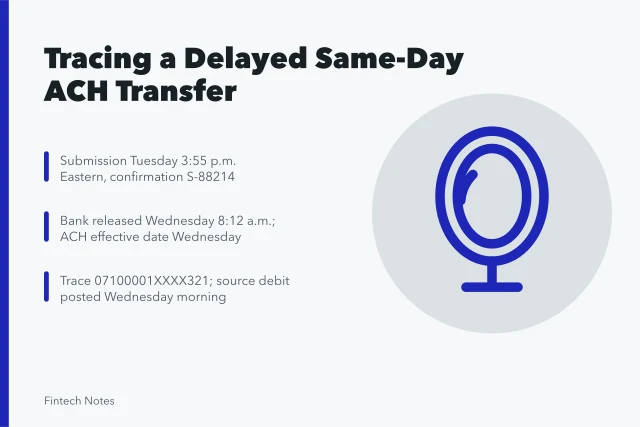
Three clocks run at once. Event time is when a person or system acted. Processing date is when a provider handled the instruction. Posting or settlement date is when a balance moved under the relevant ledger.
Three clocks running at once
Clock
- Event time
- When a person or system acted
- Processing date
- When a provider handled it
- Posting date
- When a balance moved
What it measures
- Event time
- Processing date
- Posting date
Weekends, holidays, cutoffs, time zones and batch cycles pull them apart. A "one business day" promise made Friday evening does not run on the same clock as an instant service. Quote the provider's stated rule instead of substituting your own.
Find the strongest identifier
Ask which reference exists on the rail:
Which reference exists on the rail
- App or wallet transaction ID
- Merchant order and terminal reference
- Card authorization code
- Bank reference
- ACH trace number
- Wire reference
- Instant-payment message ID
- Blockchain transaction hash
Confirm who generated each one. A public blockchain hash is not proof that a bank redemption completed. It proves a ledger transaction tied to that hash, under that chain's state, and nothing off-chain.
Test the four ledgers
For an app-to-bank payment, compare the sender app ledger, the sender funding account, the recipient app or provider ledger, and the recipient bank ledger. The transfer may exist in only some of them.
Four ledgers to compare
Ledger
- Sender app
- Debit with no funding debit: existing balance
- Sender funding account
- No debit: app drew on balance
- Recipient app or provider
- Credit with no bank credit: withdrawal pending
- Recipient bank
- Absent entry: no customer posting visible
What a mismatch may mean
- Sender app
- Sender funding account
- Recipient app or provider
- Recipient bank
A sender app debit with no funding-account debit may mean the app drew on an existing balance. A recipient app credit with no bank credit may mean the withdrawal was never requested or is still pending. Mark each entry pending, posted, reversed, returned or absent, and keep the exact wording.
Check for a paired reversal or return
A reversal offsets an earlier authorization or entry. A refund is usually a new credit after a completed purchase. A return sends an item back under the rail's rules. In a running balance they can look identical, but the identifiers and the timing differ.
Search several days either side of the original date. A pending debit may simply vanish instead of arriving as a separate credit. A posted debit may be followed by a distinct return. Ask support which pattern you are looking at.
Contact the party that controls the missing stage
Send something the provider can search.
On August 28 at 09:02 ET, transaction ID A123 for $240 was funded from the account ending 4412 to the recipient ending 8805. The app says complete, the funding debit posted, and the recipient bank shows no pending or posted credit as of August 30. Please identify the payment rail, provide its trace or reference, state whether the receiving institution accepted it, and confirm whether it settled, returned, or remains in review.
That replaces "where is my money" with facts.
Use the correct escalation path
Classify the problem first.
- Unauthorized paymentsecurity and fraud report.
- Wrong amount or duplicateerror or billing dispute.
- Authorized payment not receivedpayment trace or nonreceipt process.
- Scam-induced authorized paymentscam report and immediate recovery request.
- Service complaintprovider support, then the relevant regulator or complaint channel.
Keep confirmation numbers, promised dates, team identifiers and copies of every submission. Never post account data on social media to attract support attention.
Close the trace with evidence
Write the outcome as one of these:
- posted to recipient
- returned to sender
- authorization released
- refund credited
- duplicate corrected
- fee explained
- formal dispute opened
- unresolved and escalated
Capture the final entries. A provisional credit or a temporary hold is not a resolution.
Common questions
Can the recipient's bank trace an app transaction ID?
Often not. App identifiers usually live only inside the provider's own system. Ask the app or the sending institution for the rail-specific reference the receiving institution can actually search.
Does a posted debit prove the recipient was paid?
No. It proves a sender-side ledger event. You still need receiving-institution evidence, and for most rails you need the rail's own trace record.
Should I send the payment again while tracing it?
Wait, unless the first instruction has been conclusively canceled or returned and the payment is urgent enough to justify duplicate risk. Duplicates are far harder to unwind than delays.
Is a blockchain transaction hash enough?
It identifies an on-chain transaction. It does not prove exchange credit, token redemption, bank settlement, or that the recipient can access anything outside that ledger.