Reviews
Part of Digital wallet guide: credentials, tokens, devices, accounts, and acceptance
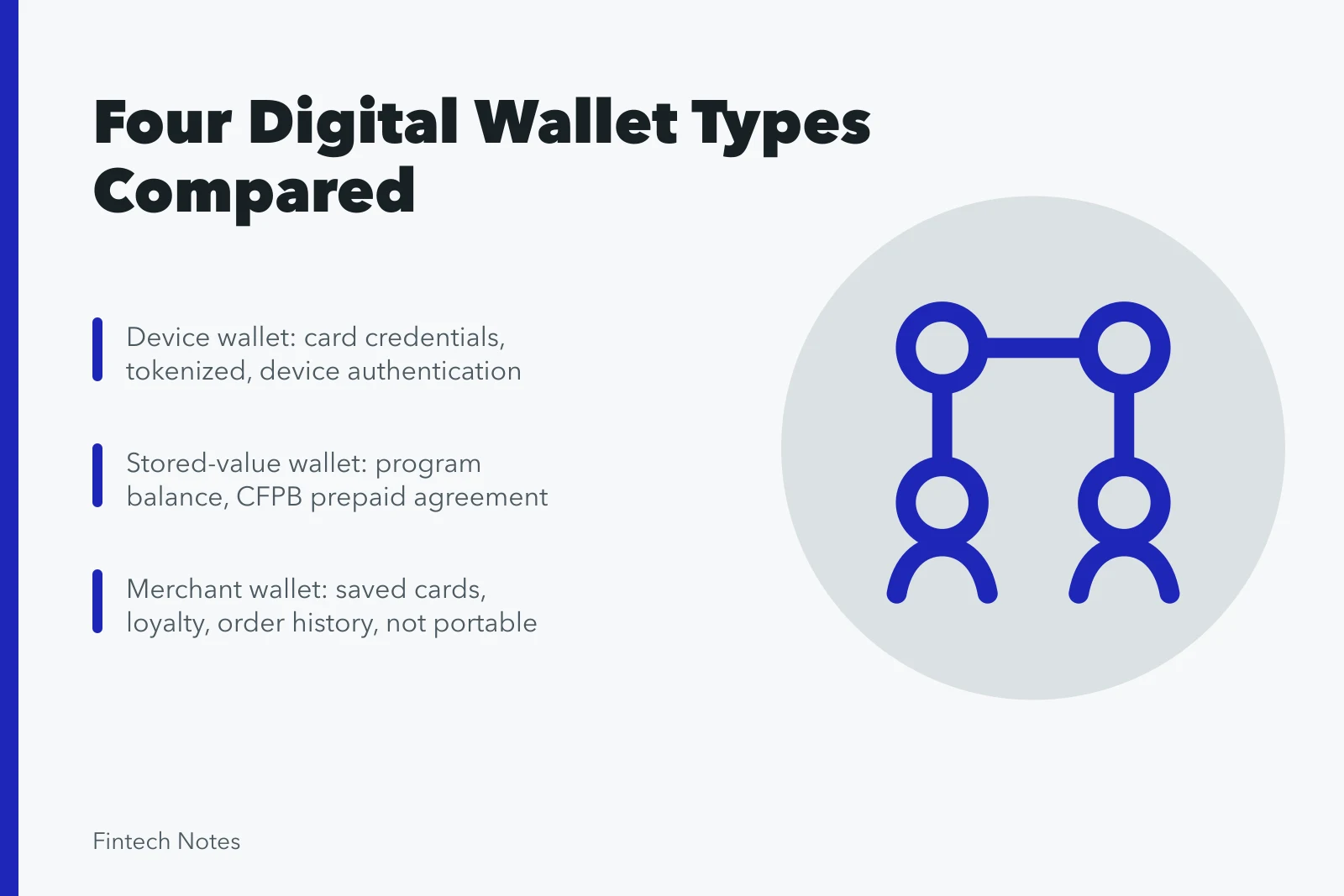
Device wallet, stored-value wallet, merchant wallet, and crypto wallet compared
Digital wallet types compared by what they hold, who controls funds or keys, where they work, how transactions settle, and how access is recovered.
What to take away
- Wallet is an interface category, not one legal or technical structure.
- Device wallets commonly present payment credentials tied to an outside card account.
- Stored-value wallets can hold a customer balance under a program agreement.
- Merchant wallets usually organize checkout, loyalty, and saved credentials inside one commercial relationship.
- Crypto wallets manage access keys; they do not contain coins in the same sense that a purse contains cash.
Four products can all use the word wallet while holding different things, moving value through different systems, and offering different recovery paths. Compare function before brand.
Side-by-side comparison
What it primarily holds or controls
- Device wallet
- Card or account credentials, often tokenized
- Stored-value wallet
- Program balance and payment instructions
- Merchant wallet
- Saved credential, loyalty value, offers, and order history
- Crypto wallet
- Private keys or signing capability
Typical acceptance
- Device wallet
- Compatible terminals, apps, and websites
- Stored-value wallet
- Program participants or connected transfer routes
- Merchant wallet
- One merchant or commercial group
- Crypto wallet
- Compatible blockchain addresses and applications
Main recovery dependency
- Device wallet
- Device, cloud account, wallet, and issuer
- Stored-value wallet
- Provider identity and account records
- Merchant wallet
- Merchant account and payment method
- Crypto wallet
- Seed, key, device, or custodian process
No row establishes deposit insurance, legal ownership, error rights, or privacy. Those require the specific agreement and facts.
Wallet types at a glance
Device wallet
- Holds
- Card credentials
- Acceptance
- Terminals and apps
- Recovery
- Device, cloud, issuer
Stored value
- Holds
- Program balance
- Acceptance
- Program participants
- Recovery
- Provider records
Merchant wallet
- Holds
- Saved card, loyalty
- Acceptance
- One merchant
- Recovery
- Merchant account
Crypto wallet
- Holds
- Private keys
- Acceptance
- Blockchain addresses
- Recovery
- Seed or custodian
Device wallets
A device wallet commonly provisions an eligible credit, debit, prepaid, or charge card on a phone or watch. It may use a substitute payment credential and require device authentication before presenting it.
What it does well
- Keeps the physical card number out of some merchant flows.
- Supports contactless and remote checkout.
- Can suspend a device credential without closing every linked service.
- Combines cards, passes, tickets, and identity items in one interface.
What it does not prove
- That the wallet holds customer money.
- That every terminal accepts it.
- That the transaction is anonymous.
- That all cards share the same dispute process.
- That deletion cancels merchant subscriptions.
When the device changes, each card may need new provisioning and issuer verification.
Stored-value wallets
A stored-value wallet records a balance that the customer can spend, transfer, or withdraw under program terms. Funding may come from a bank transfer, card, employer, government payment, another user, or merchant credit.
The CFPB's prepaid agreement database filtered for digital wallet and P2P products demonstrates that these products can identify an issuer, program manager, and other relevant party through formal agreements. The database is a research starting point. Confirm the current agreement and account status for the specific product.
Questions to answer
- Which entity owes the displayed balance?
- When do incoming funds become available?
- Is the balance held at a bank, and under what title?
- What fees apply to loading, spending, withdrawal, and inactivity?
- Can the provider freeze or offset funds?
- Which error-notice rules apply?
- What happens at closure or provider failure?
A stored balance can exist even when the app also lets the user select an outside card. Map each funding choice separately.
Merchant wallets
A merchant wallet usually centers on one retailer, marketplace, transit system, restaurant group, or platform. It may combine:
- saved cards;
- gift or loyalty balances;
- rewards and coupons;
- receipts and order history;
- delivery addresses;
- subscriptions;
- return credits.
The wallet may not be portable to another merchant. A gift balance can follow different rules from a saved bank card. A marketplace can display many sellers while processing through one customer account.
Main diligence points
Review account takeover controls, purchase notifications, stored-card removal, loyalty expiration, gift-balance terms, subscription cancellation, and data sharing. Deleting the app may leave the merchant account active on the web.
Crypto wallets
A crypto wallet manages private keys or access to a custodian that manages them. The assets are recorded on a distributed ledger, not stored as files inside the wallet interface.
The SEC's Office of Investor Education explains in its cryptoasset custody bulletin that private keys authorize transactions, seed phrases can restore some wallets, and self-custody differs from third-party custody. It also warns that losing self-custody keys or phrases can mean permanent loss of access.
Self-custody
The user controls the keys and bears responsibility for backup, transaction verification, device security, and inheritance planning. There may be no central provider able to reverse a transfer or reset a lost key.
Third-party custody
A custodian controls the keys and provides account access. Recovery may be familiar, but the customer depends on the custodian's security, solvency, withdrawals, records, and terms.
Do not store a seed phrase in a screenshot, email draft, ordinary cloud note, or support chat. Never type it into a site reached through an unsolicited message.
The word token across wallets
| Context | Meaning |
|---|---|
| Device card wallet | Substitute payment credential |
| Authentication | One-time code or cryptographic proof |
| Merchant account | Session or access token |
| Crypto network | Digital asset or protocol unit |
| Loyalty wallet | Points or merchant value |
Support staff should name the token's system and purpose. Saying only "the token expired" is not enough to diagnose a failed payment.
Settlement differences
Device card wallet
The linked card system authorizes, clears, and settles the purchase. The wallet supplies a credential and authentication context.
Stored-value wallet
The provider may adjust an internal ledger instantly, then use a separate rail for funding or withdrawal.
Merchant wallet
The merchant may charge a saved card, reduce store value, apply rewards, or combine methods.
Crypto wallet
A signed instruction is submitted to a distributed ledger. Confirmation, fees, finality, and reversibility depend on the network and service.
Privacy differences
A device wallet can involve device maker, operating-system provider, issuer, network, and merchant. A stored-value provider can observe funding and withdrawal. A merchant wallet can join purchase, loyalty, browsing, and location data. A crypto address can be publicly visible even when the owner's civil identity is not written on the ledger.
Privacy claims should specify the actor, data field, purpose, and retention period.
Recovery differences
Device wallet
- Lost phone
- Suspend device credential, restore account
- Forgotten password
- Cloud or provider recovery
- Closed card
- Reprovision replacement
- Provider failure
- Underlying card may remain
Stored value
- Lost phone
- Recover provider login
- Forgotten password
- Provider recovery
- Closed card
- May affect funding source
- Provider failure
- Balance outcome depends on structure
Merchant wallet
- Lost phone
- Recover merchant account
- Forgotten password
- Merchant recovery
- Closed card
- Replace saved credential
- Provider failure
- Account value may be at risk
Crypto wallet
- Lost phone
- Restore key or custodian login
- Forgotten password
- Custodian recovery only; self-custody differs
- Closed card
- Usually unrelated
- Provider failure
- Custody model controls access risk
Selection questions
Before adopting a wallet, ask:
- What does it hold or control?
- Which legal entity provides each function?
- Where can it be used?
- How does money enter and leave?
- What record proves a transaction?
- What data is collected and shared?
- What happens when a device or provider fails?
- Can access be recovered without the original phone?
Common questions
Is a mobile wallet always a stored-value account?
No. Many mobile wallets present credentials linked to outside accounts and hold no customer balance.
Is a merchant wallet usable everywhere?
Usually not. Its acceptance can be limited to one merchant, platform, or commercial group.
Does a crypto wallet hold cryptoassets?
It manages keys or custodial access. The asset record resides on the relevant distributed ledger.
Are payment tokens and crypto tokens the same?
No. A card payment token substitutes for an account credential within a payment system. A crypto token is a digital asset or protocol unit.