Maintenance
Part of Digital wallet guide: credentials, tokens, devices, accounts, and acceptance
Contactless payment privacy and security checklist
A contactless payment security checklist covering device hardening, wallet tokens, terminal behavior, permissions, and what to save after a bad tap.
What to take away
- Harden the phone and the cloud account first; wallet controls sit on top of both.
- Short NFC range limits one exposure and does nothing about a compromised device or a swapped terminal.
- Tokenization replaces a card number in one flow. Merchants still collect device and transaction data.
- Confirm the merchant and amount on the terminal display, not only on the phone.
- Test remote lock and card suspension while the device is still in your hand.
A contactless tap runs through several parts:
- a phone
- a radio link
- a wallet
- a token
- a terminal
- a merchant
- an issuer
- often a processor in between An audit that stops at the phone misses most of that path.
Run this as a recurring check. Product terms and the law where you live control what happens after a disputed charge.
Start with the device, not the wallet
- Run a supported operating-system version.
- Install security and wallet updates when they arrive.
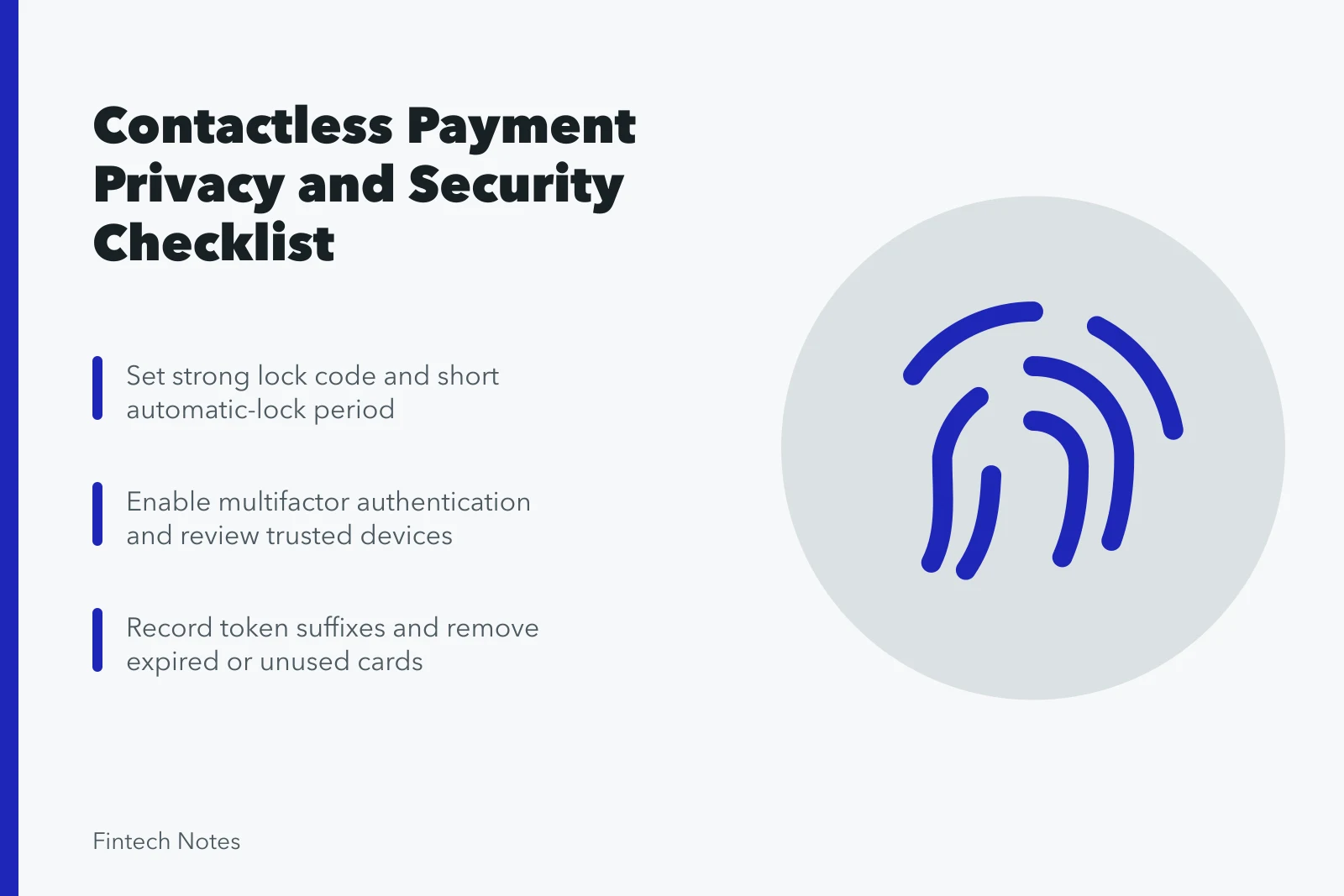
- Set a long lock code and a short automatic-lock timer.
- Check that nobody has added a fingerprint or face to biometric enrollment.
- Remove unknown profiles, certificates, and device administrators.
- Leave the phone unrooted and unjailbroken.
- List apps holding accessibility, notification, overlay, and screen-capture access.
- Encrypt backups and protect the account that holds them.
The NIST mobile communication threat catalogue describes NFC as a short-range RFID mechanism used by mobile payments, and treats each wireless and wired interface as its own attack surface. Range is one control among several.
Device hardening before wallet setup
- Run a supported operating-system version
- Install security and wallet updates
- Set long lock code, short auto-lock
- Check biometric enrollment for strangers
- Remove unknown profiles and administrators
- Leave phone unrooted and unjailbroken
- List accessibility and overlay access
The recovery account is the real password
- Give the account a password used nowhere else.
- Turn on multifactor authentication.
- Review trusted devices and open sessions.
- Protect the recovery email, recovery phone number, and backup codes.
- Turn on alerts for new devices and account changes.
- Write down the official support route somewhere other than the phone.
- Find out whether wallet data syncs across devices.
- Remove old devices after a transfer or sale.
Whoever controls the recovery email can often reset everything behind it. Audit that account before you audit the wallet.
Lock down the recovery account
- Use a password found nowhere else
- Turn on multifactor authentication
- Review trusted devices and sessions
- Protect recovery email and phone
- Alert on new devices and changes
- Write down official support route
- Remove old devices after sale
Write down what is in the wallet
| Item | What to record |
|---|---|
| Card | Issuer, last four, device, status |
| Stored balance | Provider, amount, withdrawal route |
| Watch | Paired account and active cards |
| Transit mode | Whether it works when locked, and its limit |
| Merchant credential | Provider and how to remove it |
| Pass or ID | Device-only or synced to the cloud |
Keep full card numbers, security codes, PINs, and seed phrases out of that file.
What to record per wallet item
Item
- Card
- Issuer, last four, device, status
- Stored balance
- Provider, amount, withdrawal route
- Watch
- Paired account and active cards
- Transit mode
- Works when locked, and limit
- Merchant credential
- Provider and how to remove
- Pass or ID
- Device-only or synced to cloud
What to record
- Card
- Stored balance
- Watch
- Transit mode
- Merchant credential
- Pass or ID
Tokens and card controls
- Ask the issuer whether the wallet provisions a device-specific token.
- Record the token suffix when the issuer shows one.
- Check whether phone and watch hold separate credentials.
- Confirm which card is the default.
- Remove expired and unused cards.
- Turn on issuer alerts for wallet enrollment.
- Treat an unsolicited verification code as suspicious.
- Ask whether one token can be suspended without closing the account.
A token substitutes for a card number inside a defined flow. It does not check the merchant, stop account takeover, or settle who pays after fraud.
Token and card control checks
- Ask issuer about device-specific token
- Record token suffix when shown
- Check phone and watch credentials
- Confirm which card is default
- Remove expired and unused cards
- Turn on issuer wallet-enrollment alerts
- Ask if one token can be suspended
At the terminal
- Prefer an integrated reader over a device added at the counter.
- Read the amount on the merchant display before approving.
- Keep the phone in your hand.
- Wait for the merchant's final response, not just the phone animation.
- Ask before tapping a second time.
- Take or request a receipt.
- Switch to another verified method if the terminal acts oddly.
- Report suspected tampering to the merchant and do not handle the device.
A contactless symbol does not promise that a terminal takes every wallet. Some accept contactless cards and reject a given mobile credential.
Permissions and what the app collects
Check these access types:
Permissions to tie to features
- Camera
- Contacts
- Location
- Nearby-device
- Notification
- Photo
- Microphone
- Analytics
Tie each one to a feature you actually use.
- Deny anything with no clear function.
- Choose while-in-use location where that works.
- Turn off marketing notifications that bury security alerts.
- Set ad-personalization and cross-app tracking to what you intend.
- Check whether loyalty enrollment links your identity to purchase history.
- Read the retention and deletion terms.
- Recheck permissions after major updates.
An FTC staff report on mobile payment privacy and security maps the other parties in the chain: operating-system companies, hardware makers, carriers, app developers, and loyalty administrators. Use that map to ask who receives each field. The report is old, so confirm current practices with each provider.
Reading the record afterward
- Confirm merchant and amount before authenticating.
- Compare the wallet notice against the merchant receipt.
- Pull the underlying card or account record.
- Separate pending from posted.
- Save wallet, merchant, and issuer reference numbers.
- Question any mismatch in currency or location.
- Report unauthorized activity promptly.
The wallet shows a convenience record. The issuer holds the statement that counts. Keep both.
Reconciling a payment record
- Confirm merchant and amount
- Compare wallet notice to receipt
- Pull underlying card record
- Separate pending from posted
- Save wallet, merchant, issuer references
- Question currency or location mismatch
- Report unauthorized activity promptly
QR codes are not NFC
- Check whether a sticker covers an original code.
- Confirm the destination domain or recipient.
- Read the amount and funding source before approving.
- Refuse any request to install an app or certificate at checkout.
- Do not scan codes sent by someone who called you about your account.
- Treat the code as data entry, not as proof that the payee is real.
If the phone goes missing
Write the order down before you need it:
- Mark the device lost or lock it with the remote tools you already enabled.
- Reach the wallet provider and issuer through verified channels.
- Suspend the credentials tied to that device.
- Review card, bank, stored-value, and merchant activity.
- Change exposed passwords from a different trusted device.
- Call the carrier about the SIM and the mobile account.
- Keep the time of loss, every report, and every case number.
- Erase the device when the recovery plan calls for it.
Replacing every physical card may be unnecessary when one device token is involved. Let the issuer decide after hearing the facts.
The quarterly pass
- Test remote sign-in and the loss controls.
- Remove unused cards and devices.
- Verify default and transit settings.
- Review the issuer's token inventory if it offers one.
- Check wallet privacy settings and permissions.
- Export the receipts you need for taxes or expense claims.
- Confirm you can still pay another way.
- Update your outside support contacts.
Common questions
Is contactless payment safe because NFC works only nearby?
Short range closes one door. Device compromise, account takeover, malicious apps, altered terminals, and plain payment fraud all stay open. Treat proximity as a small control, not a guarantee.
Does tokenization make a purchase private?
No. A token can stand in for the card number, while the merchant and its providers still process identity, device, location, and basket data. Tokenization limits one data element in one flow.
Should I turn NFC off when I am not paying?
That is a device and risk-preference call. Strong lock controls, wallet authentication, updates, and account monitoring matter either way, and turning the radio off does nothing about a compromised account.
What should I save after a suspicious tap?
Keep the receipt, the wallet notice, the underlying account record, and the device name.
Keep the status, the amount, and every case number. If money moved without your approval, contact the issuer's fraud line and follow the process your regulator publishes rather than acting on advice from a stranger.