Guides
Digital wallet guide: credentials, tokens, devices, accounts, and acceptance
A digital wallet guide explains credentials, tokens, devices, accounts, and acceptance, showing which company owns each layer when something breaks.
What to take away
- A digital wallet can hold a card credential, an app balance, a merchant card on file, a transit pass, or a crypto key. These are different products with different rules.
- A payment token replaces a card number in one setting. It is not money, not a bank account, and not a separate bank account.
- Contactless is how a device talks to a terminal. It says nothing about which account funds the purchase or whether the issuer will approve.
- One purchase can sit under four identifiersthe token suffix, the merchant order number, the network reference, and the card statement line.
- Recovery splits into five jobsthe device, the cloud account, the wallet, the issuer, and the funds themselves. Do them separately.
The word wallet covers at least four structures. One app presents a bank card through a device token. Another holds a stored balance the company owes you. A merchant app keeps a card on file. A crypto wallet holds private keys, not dollars.
Ask what the wallet stores, what it can instruct, and who holds the underlying account.
A functional definition
A digital wallet is software and services that organize credentials or value and present them for a transaction. It runs on a phone, watch, browser, merchant account, or dedicated device.
The Federal Reserve's 2023 payments survey glossary counts wallet payments across NFC, QR, barcode, in-app, and browser channels. It separates tokenized credentials, which use a substitute account number plus a transaction-specific code, from the printed card number.
That definition serves measurement. Your wallet agreement decides what the product actually does.
Map the five layers
Layer / Main question
- Interface
- Which app, browser, or wearable does the user operate?
- Credential
- Is it a card number, token, login, QR credential, or private key?
- Funding
- Which card, bank account, stored balance, or asset supplies value?
- Acceptance
- Which terminal or recipient can take it?
- Records
- Which parties keep transaction and recovery evidence?
Different companies usually control different layers. Removing a card from one phone does not close the card account, cancel a merchant subscription, delete a cloud pass, or withdraw an app balance.
Five wallet layers and owners
Layer
- Interface
- Which app or wearable?
- Credential
- Card, token, login, key?
- Funding
- Which value source?
- Acceptance
- Which terminal or recipient?
- Records
- Who keeps evidence?
Main question
- Interface
- Credential
- Funding
- Acceptance
- Records
Card credentials and payment tokens
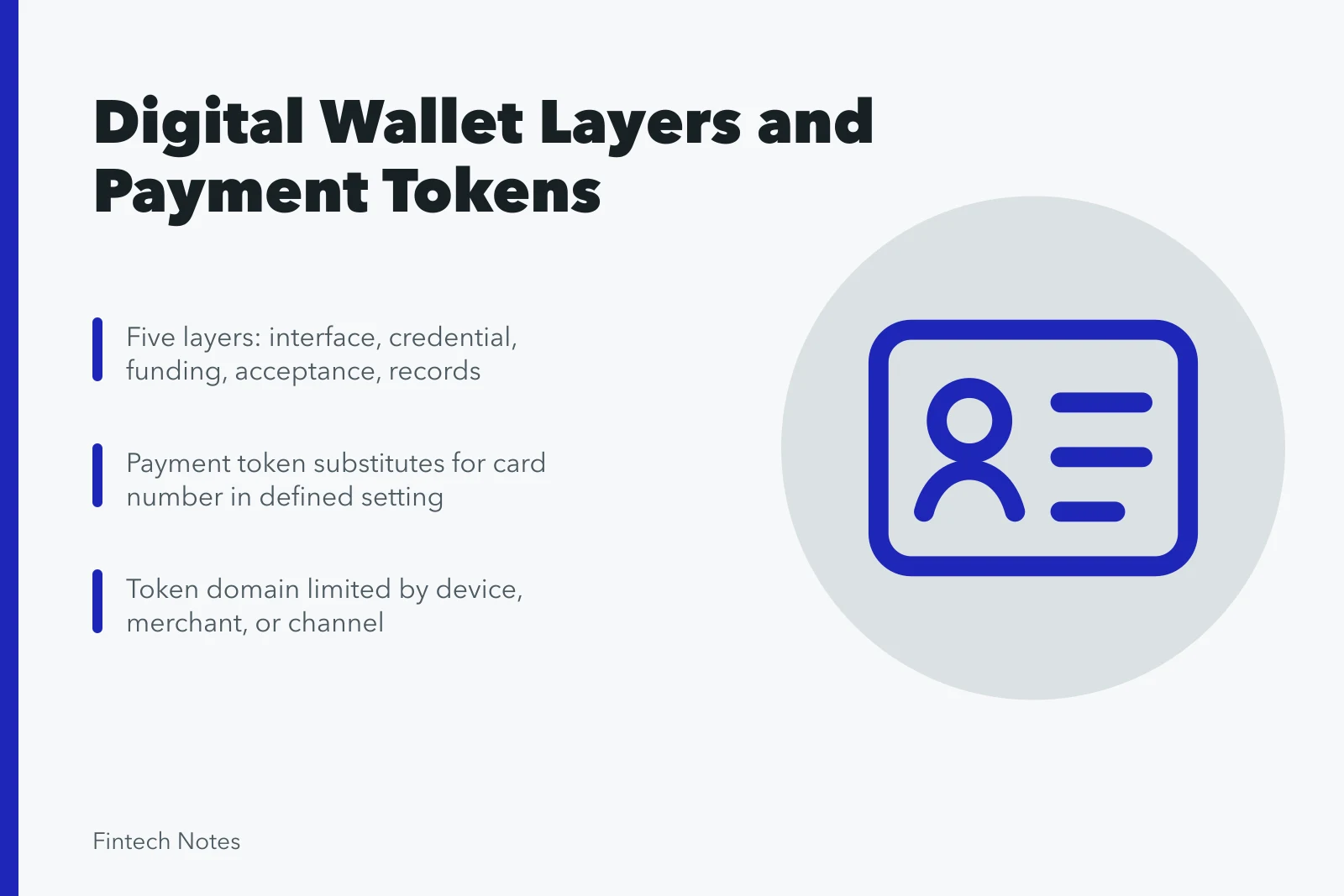
A device wallet provisions a payment token tied to an eligible card. The token stands in for the primary account number inside a defined domain, which the issuer can limit by device, merchant, or channel.
Tokenization shrinks exposure of the real account number in supported flows. It does not make a purchase anonymous, stop all fraud, or remove the issuer from the decision. The merchant still receives transaction and customer data, and other parties can link token records to an account within their role.
Five things called a token
Term
- Payment token
- Substitute credential in payment system
- Authentication code
- Evidence for one transaction
- Device identifier
- Label for hardware or installation
- Wallet account ID
- Identifier for wallet profile
- Crypto token
- Asset on distributed ledger
What it is
- Payment token
- Authentication code
- Device identifier
- Wallet account ID
- Crypto token
Device and cloud roles
Some wallet data lives only on the device. Other data syncs through a cloud account. A watch can carry its own payment credential even when paired to a phone.
So one wallet can hold several states at once: card active at the issuer, token active on the old phone, token suspended on the lost watch, pass synced in the cloud, stored balance reachable by web login.
Inventory devices and credentials. Do not treat the wallet as one object.
Contactless acceptance
Near-field communication lets a compatible device and terminal exchange data at short range. A contactless symbol marks a reader capability.
A completed payment also needs merchant configuration, wallet eligibility, a network route, an issuer decision, and acceptable transaction conditions.
A tap is a presentation step. The terminal can request a fallback, the issuer can decline, or the merchant can lack support for that wallet even when its reader takes contactless cards.
QR, barcode, in-app, and browser flows
Not every wallet payment uses NFC.
QR or barcode
The customer or merchant displays a code. Scanning may identify the recipient, open a payment request, or present a credential. Check the recipient and amount after scanning, because a printed code can be swapped.
In-app checkout
The merchant app calls a wallet or payment service, and the customer approves without retyping card details. Save the merchant order number and the wallet transaction ID together.
Browser checkout
A wallet button presents a saved credential inside a web session. Confirm the domain and the final merchant before approving.
Merchant-stored credential
A merchant may call its saved-card feature a wallet. That is usually a card-on-file arrangement, not a general device wallet. Removing a card from your phone will not remove the merchant's copy.
Stored value versus credential presentation
A wallet showing $75 might hold a program balance, mirror a bank balance, report a pending transfer, or aggregate another institution's data.
For every displayed balance, identify:
- The legal entity that owes it.
- The account or program holding it.
- Whether the funds have settled.
- The withdrawal method and timing.
- The fees and limits.
- The error-resolution process.
- The protection claim and which events it covers.
A card wallet works without holding customer funds. A stored-value wallet can hold funds without supporting tap-to-pay.
What happens during a device-wallet card purchase
A common sequence runs as follows:
Device-wallet card purchase sequence
- User authentication
- Credential presentation
- Merchant request
- Network routing
- Issuer decision
- Merchant capture
- Clearing and settlement
- user authentication
- credential presentation
- merchant request
- network routing
- issuer decision
- merchant capture
Device authentication confirms a user action under the wallet's design. It is not issuer approval. The issuer can still decline, and an on-screen checkmark may only report that the credential was transmitted.
When you dispute a charge, save the wallet transaction display and the merchant receipt or order. Also save the card statement line, the device used, and the token suffix. Save the date, amount, currency and status, plus both case numbers.
Privacy map
Possible recipients of your data include:
- the wallet provider
- the operating-system provider
- the device maker
- the issuer
- the network
- the merchant
- the acquirer
- the processor
- any loyalty program
- analytics vendors
Ask which party receives account identity, device and location data, purchase history, and loyalty activity.
Ask which party receives contacts and advertising identifiers.
Tokenizing a card number does not answer the privacy question. Read permissions and privacy notices as separate documents.
Recovery map
Prepare before a wallet loss
- Strong device lock
- Current OS and wallet
- Recovery contact and multifactor
- Remote find and erase
- Issuer phone number saved off phone
- Token inventory with last four digits
- Backup payment method and exported receipts
Also prepare:
After a loss, separating a disabled device token from a closed card matters. The issuer may suspend one credential and keep the account open. Follow its verified instructions rather than a search result.
Common questions
Does a digital wallet store my money?
Sometimes. A stored-value wallet can hold a balance the provider owes you. A device card wallet usually presents a credential tied to an account at a bank or card issuer.
Is NFC the same as tokenization?
No. NFC is a short-range way for a device and terminal to communicate. Tokenization substitutes a credential for a card number. Products use them together, but either can exist alone.
Does a tokenized purchase skip the issuer?
No. A typical card-wallet purchase still reaches the issuer for an authorization decision, and the issuer can decline it.
Will deleting the wallet cancel my subscriptions?
Not necessarily. Merchant-stored credentials and the contracts behind them survive. Cancel through the merchant's own documented process.
In this guide
- How to set up and audit a mobile wallet safelyA mobile wallet borrows its security from the phone, the cloud account and the card issuer, so setup and audit form one continuous sequence.
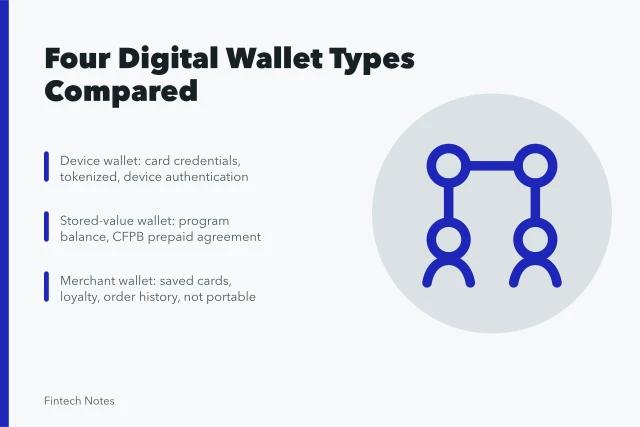
- Device wallet, stored-value wallet, merchant wallet, and crypto wallet comparedDigital wallet types compared by what they hold, who controls funds or keys, where they work, how transactions settle, and how access is recovered.
- Contactless payment privacy and security checklistA contactless payment security checklist covering device hardening, wallet tokens, terminal behavior, permissions, and what to save after a bad tap.