Guides
Money Transmitter License Lookup: What to Check Before You Deposit in a Fintech App
A fintech money transmitter license lookup shows which states license an app and which rely on a sponsor bank. Check the right database before you deposit.
What to take away
- Most fintech apps that hold or move your money are not licensed as banks. Either the app holds state money transmitter licenses, or a sponsor bank does the regulated work.
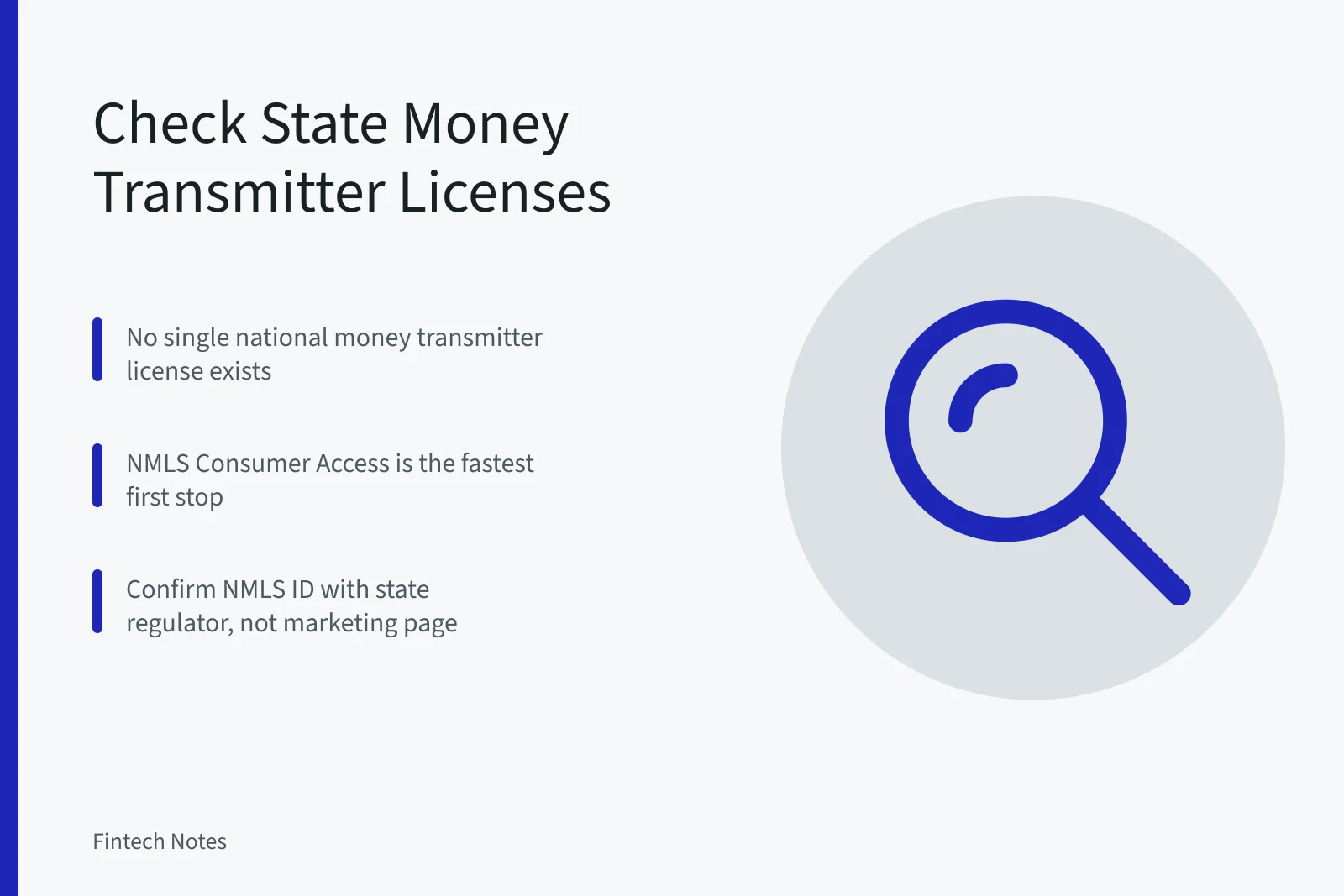
- Every state runs its own lookup. There is no single national money transmitter license, so you check the state where you live.
- The Nationwide Multistate Licensing System (NMLS) Consumer Access portal is the fastest first stop, but it is not the last word.
- A license number on a marketing page proves nothing. Confirm the legal entity name, the license status, and the states covered.
- If an app cannot name its sponsor bank or its state licenses in writing, treat that as an answer, not a delay.
Three scopes that are different jobs
The first job is confirming who holds your money. A fintech app may be a program manager that rents a bank's charter, or it may hold state money transmitter licenses itself. Those are different legal structures with different protections.
License vs Sponsor Bank
State money transmitter license
- Who holds funds
- Fintech entity
- Who regulates
- State regulators
- Where you check
- State lookup, NMLS
- Your recourse
- State regulator complaint
Sponsor bank exemption
- Who holds funds
- Partner bank
- Who regulates
- Federal and state bank regulators
- Where you check
- FDIC bank directory
- Your recourse
- Bank plus regulator
A money transmitter license is issued by a state, not by a federal agency. A company can be licensed in 40 states and unlicensed in yours. The license covers money transmission in that state only.
A sponsor bank exemption works differently. When a bank holds the deposits and the fintech is only a service provider, the fintech may not need its own license in some states. That is legal. It also means your recourse runs through the bank, not the app.
Questions to ask before you deposit
Write these down and send them to support. Keep the reply.
Five Questions Before You Deposit
- Full legal name of entity holding funds
- Is entity a bank, or which sponsor bank
- Which states hold active money transmitter license
- What is the NMLS ID and coverage
- If app closes, who returns balance and timeline
A support agent who answers all five in one reply is a good sign. A reply that redirects you to a help article is not.
Evidence to request
Ask for the NMLS ID in writing. Then verify it yourself at the state regulator's lookup, not just on the company site. The Wikipedia overview of money transmitter regulation explains why the state-by-state structure exists and what a license actually authorizes.
Verify the License Yourself
- Ask for NMLS ID in writing
- Verify at state regulator lookup
- Request sponsor bank name
- Confirm bank in FDIC directory
- Ask if balance is FDIC-insured or pooled
- Ask how errors are handled under Regulation E
Request the name of the sponsor bank and confirm the bank is real. The FDIC keeps a bank directory, and a real sponsor bank will appear there. Ask whether your balance sits in an FDIC-insured account at that bank or in a pooled account the app controls.
For any product that moves money electronically, ask how errors are handled. Regulation E sets error resolution deadlines, and the official CFPB Regulation E text is the standard to compare against. A fintech that cannot describe its error process is a fintech you cannot audit.
Answers that should end the conversation
Some replies are disqualifying. Walk away when you hear them.
- "We are fully licensed" with no entity name, state list, or NMLS ID.
- "Your funds are FDIC insured" when the app is not a bank and will not name the sponsor bank.
- "We are regulated like a bank" or "we follow bank rules" with no regulator named.
- "Our license covers all 50 states" when no single state license does that.
- "Contact us after something goes wrong" in place of a written error-resolution process.
Before you commit, run the company through the official CFPB Consumer Complaint Database. A pattern of complaints about frozen balances is more useful than any marketing page.
Comparing licensed and sponsor-bank models
State money transmitter license
- Who holds funds
- The fintech entity
- Who regulates
- State regulators
- Where you check
- State lookup, NMLS
- Failure risk
- State insolvency rules apply
- Your recourse
- State regulator complaint
Sponsor bank model
- Who holds funds
- The partner bank
- Who regulates
- Federal and state bank regulators
- Where you check
- FDIC bank directory
- Failure risk
- Bank resolution applies
- Your recourse
- Bank plus regulator
Neither model is automatically safer. The question is which one you are actually in, because that determines who you call when the balance does not move.
What the agreement must say
The terms of service should name the legal entity that holds your funds. It should state whether that entity is a bank or a licensed money transmitter. It should list the states where the license is active, or name the sponsor bank if the exemption applies.
It should describe the error resolution process and the timeline for a disputed transfer. It should say what happens to your balance if the service shuts down. If any of those are missing, ask in writing and keep the answer.
A due-diligence pass should not stop at the license. The digital bank and finance app due-diligence checklist covers the account terms, fee schedule, and insurance claims to review next, and it pairs well with the license check you just ran.