Reviews
Part of Digital finance security guide: identity, authentication, fraud, and recovery
Authentication methods compared: password, passkey, one-time code and hardware key
Authentication methods compared across phishing resistance, device loss, enrollment, recovery, portability, verifier risk, and finance-account use.
Start with the failure point, not the label on the sign-in screen. A useful comparison asks what the user presents, what an attacker could capture, and how legitimate access returns after device loss. The answer changes across login, enrollment, recovery, and payment approval.
Reusable secrets: contain the exposure
Passwords still work across devices, but their convenience does not remove the risk of a shared secret. Their value depends on selection, storage, and recovery, so compatibility alone is not a sound single control for high-impact financial actions. A better version reduces avoidable reuse without pretending the method itself changes.
Weak version. The user reuses a password and types it into a convincing imitation of the service. Stolen verifier data can expose accounts too, while recovery through guessable questions may undo a strong original password. In this arrangement, familiarity masks how many points can fail.
Better version. Use a unique, generated password and keep it in a manager, while remembering that a person can still type it into a fake payment page. A password manager improves credential handling, but does not turn a shared secret into a phishing-resistant login. Review the surrounding payment credential flow, not only the saved entry.
Codes that expire: distinguish delivery from resistance
One-time codes add an expiry window, but delivery by text and generation in an app are not identical, nor does a short lifetime stop real-time relay.
Compare each method's exposure and recovery arrangements instead of treating every temporary code as equal protection. The weak and better versions show why expiry alone is not enough.
Weak version. The user submits a current code to a phishing site or reads it to someone impersonating support. An attacker can relay it to the genuine service before expiry. Text delivery also ties access to restoring the same phone number after a device change.
Better version. Treat SMS and email as weaker fallback options, not as proof against phishing. CISA's guidance favours stronger choices, including security keys or number matching where available. For an authenticator app, decide how its seed will be backed up, transferred, or replaced; a brief code window alone does not make it phishing-resistant.
Domain-bound credentials: prepare for another device
A passkey changes the credential model: the service stores a public key, while the private key stays with the user's device or credential provider. Domain binding makes a conventional look-alike page less effective. Its practical strength still depends on whether the credential can be restored or used on another device.
Weak version. Enrollment leaves portability unexplained. A passkey could be synced through a platform account or tied to one device, and those arrangements differ when a device disappears. Assuming every passkey moves in the same way can block legitimate return or leave the platform account outside the security review.
Better version. Before enrollment, identify whether the passkey is device-bound or synced, what local user verification is required, and how another credential can be enrolled. Decide how a new device is approved, what notices follow enrollment or removal, and whether support can bypass the expected checks.
Physical keys: avoid a single point of loss
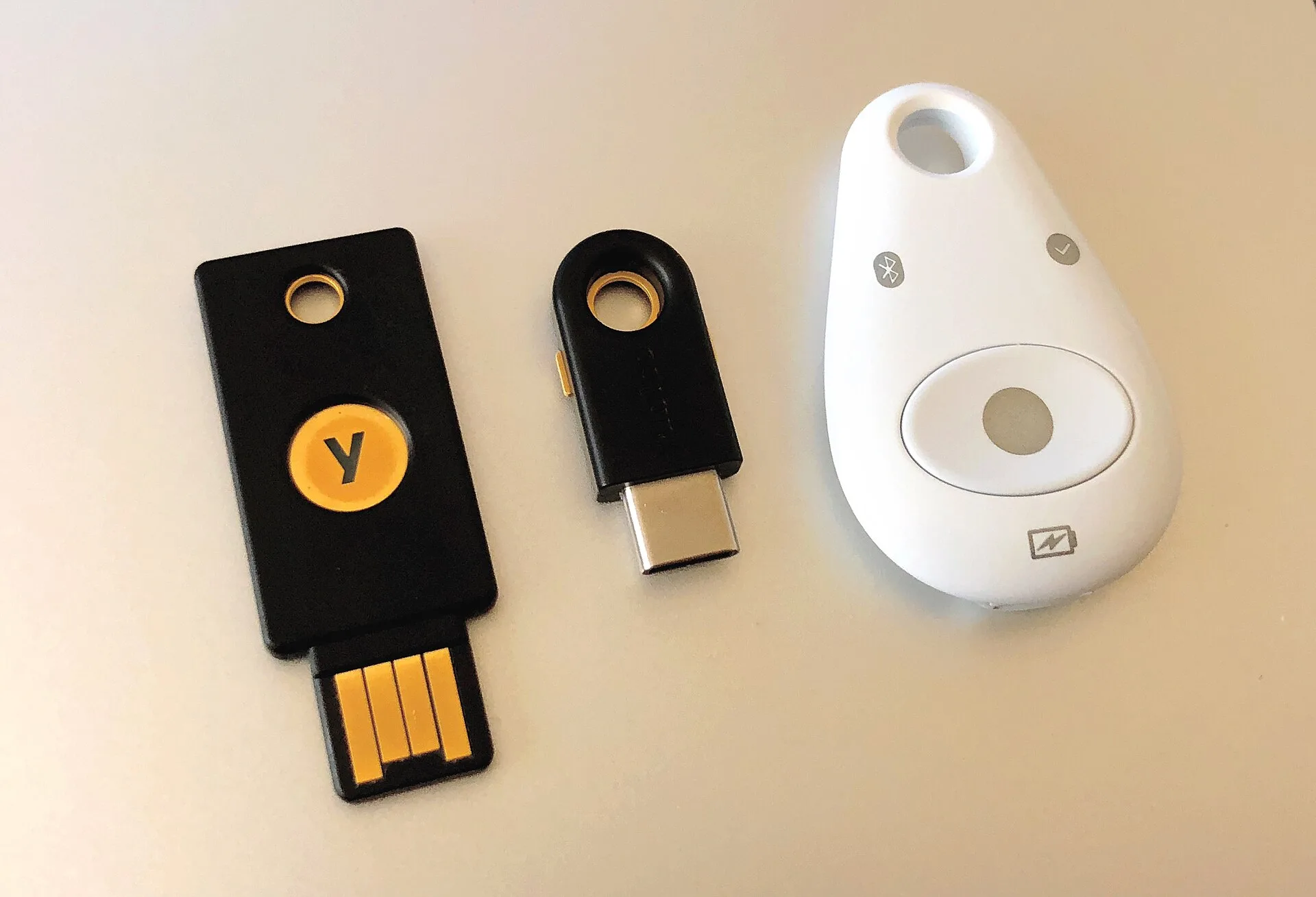
A separate hardware key keeps a cryptographic credential on a physical device. In compatible FIDO deployments, the key can verify the legitimate domain without sending a reusable secret. That provides strong phishing resistance when both the deployment and account processes support the method in use.
Weak version. One key is lost, damaged, or left behind, or the service does not support it. The user's strongest login then becomes unusable, while the account has no ready alternative. Even a strong sign-in method fails operationally if a missing key cannot be removed through a reliable process.
Better version. Enrol a second key before it is needed, protect both from unauthorised use, and record how either can be removed. NIST's authentication and authenticator-management requirements distinguish phishing-resistant authentication from methods requiring manual entry of outputs, and address recovery separately. Its scope is federal digital identity systems, so private services must assess their contracts, law, risks, and users.
Recovery after device loss: test the return path
Recovery can undo the advantage of a stronger login if support replaces an authenticator after weak identity checks. Match the return path to account risk, notify trusted channels, and test it before a device is inaccessible. Review the provider's support and exit process as part of that assessment.
Weak version. If support replaces an authenticator after checking only public biographical facts, an attacker may bypass the stronger sign-in. A process relying on an unrecorded seed, an unavailable device, or unclear removal steps can strand a legitimate user. NIST's account recovery material treats recovery as its own part of identity management.
Recovery scenarios to test
- Phone lost but email secure
- Email compromised but phone secure
- All daily devices lost
- Mobile number transferred by attacker
- Platform account suspended
- User cannot complete biometric gesture
Better version. Test lost-device and inaccessible-account situations before relying on a method. Make enrolled devices and keys visible and removable, notify old and new channels after security changes, and revoke sessions when authenticators are reset. Keep an accessible alternative, but do not let recovery depend on guessable facts or an undocumented seed.
Payment consent: bind approval to the details
Authentication shows control of an authenticator at a particular moment; it does not show that the user checked a payment's amount and destination. Treat sign-in and transaction approval as separate decisions, especially when the action is sensitive or difficult to reverse for the account holder.
Weak version. The service treats a successful login or a generic one-time code as proof that a named payment was approved. The user's review of the amount, destination, and other material details is not tied to the action, even though the authentication event itself succeeded.
Better version. Show material payment details on a trusted screen and require clear approval. Reauthenticate when risk changes, but do not claim a generic code proves the user approved exact transfer details. Keep the account login comparison separate from the payment-approval decision.
Use this short assessment to compare a method before adoption with the safer arrangement that should be available in use. It draws on the checks above: credential strength, fallback arrangements, recovery, change notifications, accessibility, and confirmation of the intended payment for high-impact activity.
- Prefer phishing-resistant methods for high-impact access.
- Support two independent authenticators where practical, with devices visible and removable.
- Test device loss, account recovery, and inaccessible-account scenarios.
- Notify trusted channels after security changes and revoke sessions after authenticator resets.
- Assess accessibility and payment approval separately from login strength.