Rules
3 Miami remittance and stablecoin rules for Latin America corridors
Miami remittance and stablecoin rules come from three sources: Florida money transmitter licensing, FinCEN MSB registration, and stablecoin freeze risk.
What to take away
- Miami remittance and stablecoin rules stack three layers: Florida money transmitter licensing under Chapter 560, federal FinCEN registration as a money services business, and the issuer-level freeze controls built into most stablecoins.
- Senders using apps and storefront agents in Miami rarely hold the license themselves, but the company moving the money must, and Florida's Office of Financial Regulation (OFR) is the state regulator that checks.
- FinCEN registration is federal and separate. It brings a written AML program, a designated compliance officer, recordkeeping, and Suspicious Activity Report filing duties.
- Stablecoins can settle a Miami to Latin America transfer in minutes, but the issuer can freeze a wallet address, and a frozen balance is not spendable while you wait.
- Corridor rules differ by destination. Mexico, Colombia, Guatemala, Honduras, and the Dominican Republic each impose their own identification and reporting requirements on the receiving end.
- Before sending, verify the sender's state license status, the FinCEN registration number, the disclosed exchange rate, and the fee in dollars rather than a percentage.
Florida money transmitter licensing for Miami senders
Florida regulates money transmission under Chapter 560 of the Florida Statutes, administered by the Office of Financial Regulation. Anyone who receives money in Florida for transmission to another person or place generally needs a money transmitter license, unless a statutory exemption applies.
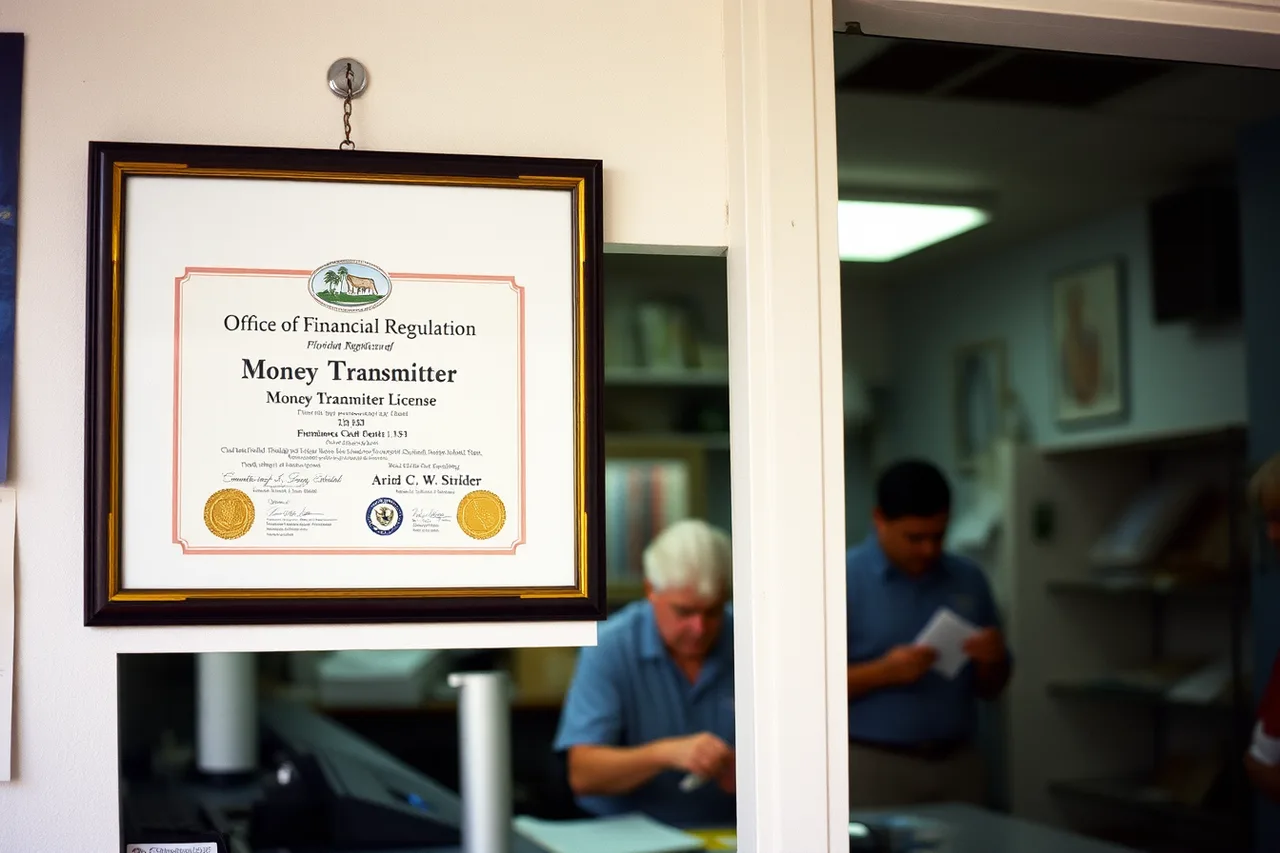
That covers the obvious cases: a remittance storefront on Flagler Street, a courier who carries cash to a partner in Honduras, and an app that accepts dollars from a Miami customer and pays out pesos in Bogota.
It also reaches some businesses that do not think of themselves as remittance companies, such as a check casher that also wires funds abroad.
Licensing is not a one-time filing. Florida requires a surety bond, a minimum net worth, background checks on principals, and ongoing reporting. The OFR can examine records and suspend a licensee. A company operating without the license is exposed to enforcement and, more practically for customers, has no regulator standing behind the funds.
The OFR sets the bond and net worth amounts by rule. As a typical starting point, a small Florida transmitter posts a surety bond of about $50,000 and shows a minimum net worth of about $100,000.
Both amounts can rise with the volume a licensee transmits, and the OFR states the current figures with the license application.
For a Miami sender, the practical question is not whether you are licensed. It is whether the company you hand money to is. Florida publishes licensee information, and the OFR's consumer resources let you check a name before a first transfer.
Exemptions exist and are narrow. An agent of a licensed transmitter can operate under the licensee's umbrella, which is how many small Miami storefronts function. The agent is not separately licensed, but the licensed company remains responsible for the agent's conduct and recordkeeping.
If a Miami business wants to build its own corridor, the cheaper path is usually to become an agent of an existing licensee rather than apply for a standalone Florida money transmitter license. That route still requires a written agreement, training, and compliance monitoring by the principal.
FinCEN registration and BSA duties for remittance firms
Federal registration is a separate obligation. A money services business, including a money transmitter, must register with FinCEN and renew that registration every two years. About FinCEN explains the bureau's role in administering the Bank Secrecy Act for these firms.
Registration is not a license. It does not authorize a business to operate in Florida or any other state, and it does not substitute for state licensing. It is a federal identification and reporting step, and it applies even to a small operation.
Once registered, a money transmitter must have a written anti-money laundering program, designate a compliance officer, train staff, and arrange for independent review. It must file Currency Transaction Reports for cash transactions above $10,000 in a business day and Suspicious Activity Reports when it knows or suspects a transaction involves illicit funds.
Recordkeeping rules require identification of senders for transfers at or above $3,000, and the information travels with the payment. That is why a Miami customer sending money to family in Guatemala is asked for a full name, address, and identification document even on a small transfer.
Bank Secrecy Act Filing Information sets out which forms apply to money services businesses and how they are submitted. Firms also rely on FinCEN financial institutions resources, which cover MSB registration and the registration form itself.
Enforcement has moved toward crypto and money transmission channels in recent years. FinCEN alerts and advisories describe typologies the agency expects firms to monitor, including convertible virtual currency and the misuse of money transmission services.
The agency also publishes AML and money transmitter guidance aimed at fintech and crypto platforms, which sets expectations for how these businesses build controls.
For a Miami customer, the visible effect is paperwork. For the business, the effect is cost: compliance staff, monitoring software, and filing obligations that do not scale down for small operators.
Stablecoin use in Miami to Latin America corridors
Stablecoins have become a real settlement channel on Miami to Latin America transfers, largely because correspondent banking in some corridors is slow or expensive. A sender can buy a dollar stablecoin, send it to a wallet controlled by a recipient or a local payout partner, and the recipient converts to local currency.
The mechanics matter. Most dollar stablecoins are issued by a company that maintains a list of wallet addresses it has frozen. If an address is on that list, the tokens cannot move. The holder still sees a balance, but the balance is inert.
That is the central risk in this corridor. A recipient in Venezuela or Argentina may prefer stablecoins precisely because local currency is unstable, yet the same token can be frozen by the issuer if it is linked to a sanctioned address, a stolen-funds investigation, or a compliance review.
Freezes are not hypothetical. Issuers have frozen addresses tied to hacking proceeds, sanctions evasion, and law enforcement requests. For a legitimate Miami sender, the exposure is usually indirect: a payout partner, an over-the-counter desk, or an intermediary in the chain gets flagged, and funds upstream of that point stop moving.
This is one reason comparison shopping across rails matters. How electronic money, and stablecoins differ on reversibility, speed, and who can stop a payment is the part that decides your outcome, and stablecoins score poorly on the last point.
Cost is also not always what it appears. A token transfer can look cheap on a low-fee network, but the on-ramp and off-ramp carry spreads. The purchase in Miami and the conversion to pesos or quetzales at the other end often cost more than a traditional remittance fee.
The three rules: state license, FinCEN registration, and recall terms
The title promises three rules. These are the ones that actually change what happens to a Miami transfer.
Rule 1: State licensing under Chapter 560. The company handling your transfer must hold a Florida money transmitter license or operate as an agent of a licensee. This determines who you can complain to when a transfer fails, and it determines whether the OFR can act.
Rule 2: Federal FinCEN registration and BSA compliance. The same company must be registered with FinCEN and run an AML program. This is why identification is collected, why large cash transfers are reported, and why a suspicious transfer can be delayed or blocked.
Rule 3: Payout partners control whether a transfer can be recalled. Florida and federal law do not guarantee that a mistaken transfer can be recalled. Once funds are paid out in the destination country, recovery depends on the receiving institution and the local payout partner, not on the Miami sender's bank.
A worked example shows how the three interact. A Miami customer sends $3,000 to a recipient in Honduras through a licensed agent. The agent collects identification because of the federal recordkeeping rule, and the transfer is paid out in lempiras.
Two days later the customer realizes the account number was wrong and asks for a recall. The state license gives the customer a regulator to complain to, and the federal registration gives FinCEN a record of the transaction.
Withdrawal and freeze risks for Miami users
Freeze risk has two forms for Miami users, and they are often confused.
Platform freeze: a crypto exchange or app restricts your account, usually during a compliance review or after a flagged deposit. Your balance shows, but withdrawals are blocked. This is the pattern behind the digital payments guide, where a platform keeps balances visible while payouts stop.
Issuer freeze: the stablecoin issuer blacklists a specific wallet address. This is a property of the token, not the platform, and it can happen even if your exchange account is in good standing.
Tether, the issuer of USDT, and Circle, the issuer of USDC, both maintain address blacklists. Tether froze about $225 million in USDT in November 2023, working with OKX and the US Department of Justice on a case tied to a Southeast Asia scam network.
Withdrawal limits are a related trap. Many platforms cap daily or monthly withdrawals, and a new account may face a holding period before funds can leave.
A Miami user who buys a stablecoin on Friday and needs to send it to Colombia on Saturday may find the withdrawal window closed. Ask for the exact limit in writing before you need the money out.
Recovery is slow and uncertain in both cases. A platform freeze usually requires submitting documents and waiting. An issuer freeze may require a legal process or a law enforcement request, and there is no standard timeline for either.
This is why the redemption path deserves attention before you commit funds. Following the verify finance app money path to a bank account shows how many steps sit between a token balance and spendable dollars, and each step is a point where a hold can appear.
What to verify before sending money south
Use this checklist before a first transfer on any new service, and repeat it when a provider changes its terms.
- The company appears on the Florida OFR licensee list, or it names the licensed transmitter it operates under as an agent.
- The company's FinCEN registration number is available on request or on its site.
- The exchange rate is quoted in writing, with the fee stated separately in dollars.
- The total cost is compared against at least two other providers on the same corridor.
- The payout method in the destination country is named, whether bank deposit, cash pickup, or mobile wallet.
- The recall policy is in writing, including what happens if the recipient details are wrong.
- If stablecoins are involved, the issuer's freeze policy and the withdrawal limits on your account are known.
Provider screening deserves the same attention as price. A digital account problems review of any app you use tells you more than a fee table does, because the ability to withdraw matters more than the headline cost.
Corridor-specific checks matter too. Mexico, Colombia, and Brazil have their own identification and reporting rules for incoming funds, and a payout partner may require the recipient to register before collecting. Ask the provider what the recipient must bring.
Corridor pricing is not uniform. The World Bank's Remittance Prices Worldwide series has put the average cost of sending $200 to Mexico in the 4 to 5 percent range. Colombia and Honduras typically cost more per dollar sent, partly because cash pickup adds a handling step that a bank deposit avoids.
Finally, keep the receipt and the transaction reference. If a transfer goes wrong, the reference number is what the OFR, the provider, or a bank will ask for first. Problems with wrong recipients, cutoffs, scams are far easier to resolve with a reference than with a memory of the transaction.